


RF over Fiber (RFoF) is an important building block in commercial and defense implementation of modern satcom and telecom architecture. It provides a significant leap over fully digitized networks by maintaining an analog RF signal but changing the transportation medium to ultra-low-loss fiber optics. [1, 2, 3] RFoF specifically designed for the feeder link bandwidth of up to 6GHz provides signal content bandwidth that can’t be matched by DIFI.
What is 3GPP [0]?
The 3rd Generation Partnership Project (3GPP) is the global organization that develops and maintains technical specifications for mobile telecommunications, including 3G, 4G (LTE), 5G, and emerging 6G networks. It unifies seven regional telecommunications standard development organizations to ensure worldwide compatibility and interoperability between networks and devices.
What is RFoF?
Instead of transporting RF signals (or any telecom electromagnetic channel) over coax or waveguides converting the satellite’s waveform into packets, 6 GHz RFoF utilizes analog optical modulation [4] either by direct or external modulation depending on the frequency and bandwidth required.
- The Mechanism: An analog RF signal (up to 6 GHz is required for IF feeder link) is fed directly into an optical transmitter at the antenna after down converting to intermediate frequency (IF). A specialized, high-linearity laser diode converts the electrical voltage changes directly into matching light intensity changes (intensity modulation). [5]
- The Medium: The electromagnetic signal is converted to an analog optical wave that can travel over thousands of meters of single-mode fiber optic cable to the indoor gateway equipment. [6]
- The Recovery: On the receiver side, a photodiode converts the light back into an identical electrical analog RF signal. The process is completely transparent to the communication protocol, allowing it to accommodate spread-spectrum and other advanced modulation techniques to remain future-proof. [6]
Why specifically 6 GHz?
The 6 GHz limit is highly intentional, serving as a critical commercial sweet spot for two distinct architecture reasons:
- Extending Beyond Traditional L-Band IF: Historically, ground antennas used a low Intermediate Frequency (IF) called the L-Band (950 MHz – 2150 MHz) to prevent massive signal attenuation over coaxial cables. By moving to RFoF, operators can ditch L-Band limits. A 6 GHz wideband optical link allows an antenna to process massive chunks of spectrum at a much higher IF (spanning the S-band, C-band, or wide pieces of distributed Ku/Ka bands) without down-converting to a crowded L-band space and down conversion of K and Ka signals into 6GHz IF signal . [5, 8]
- Direct C-Band Uplink Transport: Commercial C-Band communications operate roughly between 3.4 GHz and 6.7 GHz. Because RFoF equipment easily tops out at 7 GHz, operators can route native C-Band RF signals directly from the indoor control room up to the dish via fiber without doing any frequency conversion at all at the antenna. [1]
RFoF vs. Digitized (Digital IF)
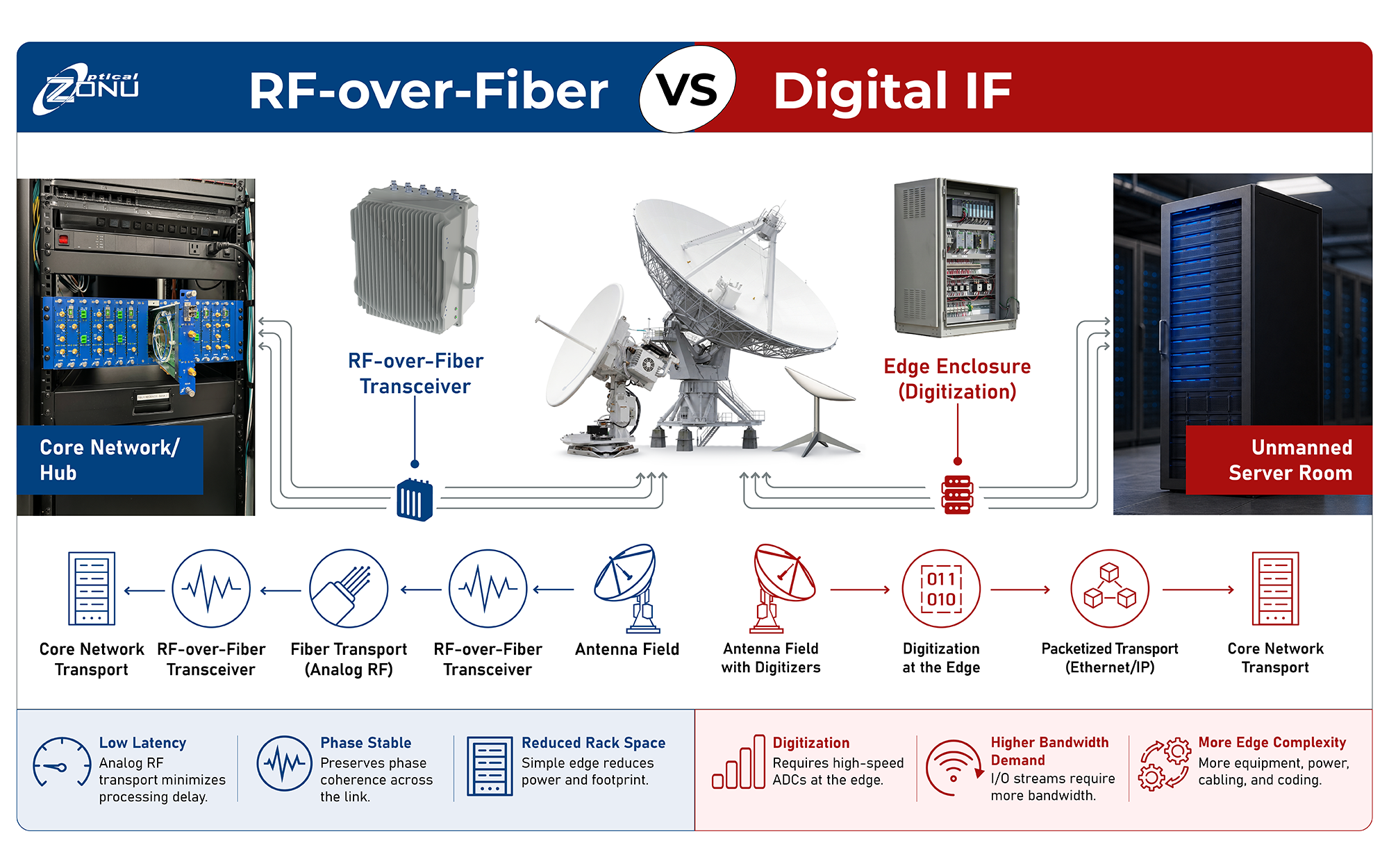
In modern satellite teleport designs (e.g. 3GP)), 6 GHz RFoF competes directly against digitized architecture (like the DIFI standard):
- The Performance Advantage: Analog RFoF does not require expensive, power-hungry, high-speed Analog-to-Digital Converters (ADCs) at the antenna dish. There is zero quantization noise, zero processing latency, and it handles massive instantaneous bandwidth easily. [10, 11]
- The Vulnerability Advantage: Fiber optic cable does not pick up local cellular or electrical interference (EMI), protecting the high-fidelity satellite signals from getting ruined on the way to the server racks. [2] It enables redundancy path and systems to recover automatically from any single point of failure (utilizing N+1 redundancy architecture).
- The Tradeoff: RFoF is still an analog signal inside a fiber line and is subject to physical fiber impairments like dispersion, laser noise, and optical reflections. To use it effectively requires specialized design not currently produced for mass markets. Digitized data over fiber, conversely, can be routed globally across standard IP network switches without any signal degradation. [8, 10, 11, 12]
Hardware vendors like manufacture field-hardened, commercially successful 6 GHz optical links specifically to replace bulky coax copper trunks at satellite gateways. [4, 9, 12]
[1] https://ja.sanlandtech.com
[2] https://www.microwavejournal.com
[5] https://dev-systemtechnik.com
8] https://www.microwavejournal.com
[10] https://www.kratosspace.com
[11] https://www.octanewireless.com
[12] https://www.opticalzonu.com