

Carrier/Data-Center Grade
Home » Solutions » Timing / Distribution (GNSS) » Carrier/Data-Center Grade

For applications that require the highest levels of reliability and redundancy Optical Zonu offers a carrier grade line of GNSS GPS over fiber equipment designed for use in cellular and datacenter applications. These types of systems are designed where every level of hardware is fully redundant. Multiple transmitters can be installed on different power sources in different locations of the roof to guarantee that service never goes down. The rackmount receivers have multiple power supplies as well as multiple optical receivers. A common output path can be fed with an RF auto switch that will automatically provide a good signal at the output.
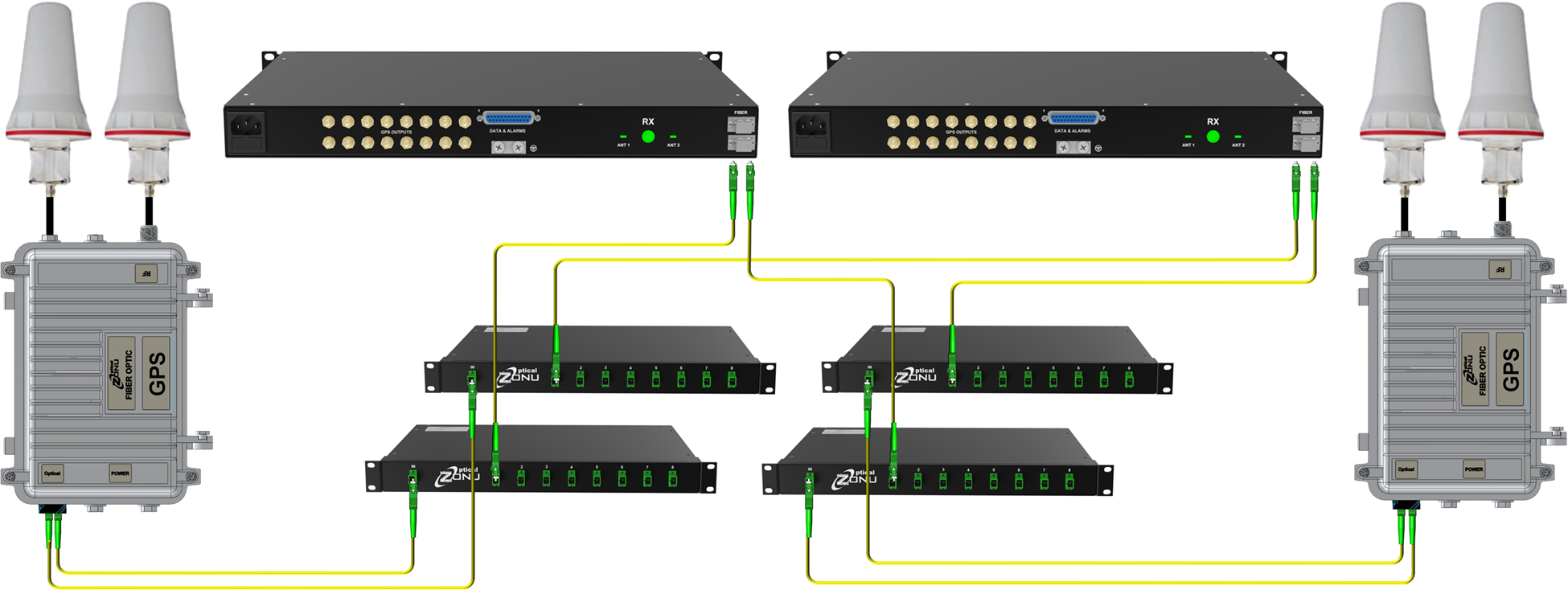
The above architecture illustrates one of these types of systems. The architecture illustrates the highest level of datacenter redundancy; implementing 4 optical transmitters and 4 optical receivers. Optical splitters are used to provide service to multiple rack locations. Ideally, the outdoor transmitters should be installed on opposite sides of the buildings to provide protection from lightning strikes.
These architectures can be custom tailored to specific applications. Depending on how much redundancy or capacity is required, the same commercial components can be added or removed to a system to meet specific needs. Contact a sales engineer for assistance in designing a system that best meets your needs.
GNSS / GPS over Fiber FAQ
What is GPS/GNSS over fiber? Distributing the signals of the location signals from satellite enable longer distance from the antenna. On locations where timing signal is required, e.g. BaseStation, Server Farms, that are either underground or far away from antenna location with sky view the RF signals received from multiple satellites are transported over fiber (RF over Fiber = RFoF). Modern system enable full redundancy, multiple antennas for backup and alternative fiber routes for security.
How does GPS/GNSS over fiber work? The RF signals received from the antennas are converted into optical signal emitted form a laser – transported over single mode or multi-mode fiber – and converter back to RF signal via a Photodetector (PD) that has the proper bandwidth to accommodate signal transport without disruption of the signal to noise ratio.
What are the advantages of GPS/GNSS over fiber? Utilizing RFoF of GPS over fiber (also GNSS over Fiber) enable longer distance from the antenna to the equipment, redundancy, resilience from EMI interference, and multipoint distribution via optical splitting AND RF splitting at the receiver.
Why use fiber instead of coax for GPS/GNSS timing? Coax attenuation impact signal to noise ratio for distances over 10m. GNSS signals are at the approximate frequency of 1.6 GHz – coax distribution is not practical due to the excess attenuation.
Can GPS/GNSS over fiber support long-distance antenna installations? RFoF enable seamless signal transport and splits of kilometers range – basically enable any distance from the antenna to the edge equipment.