

Timing / Distribution (GNSS) - Modules
Home / Solutions / Timing / Distribution (GNSS) / Modules

Plugin modules
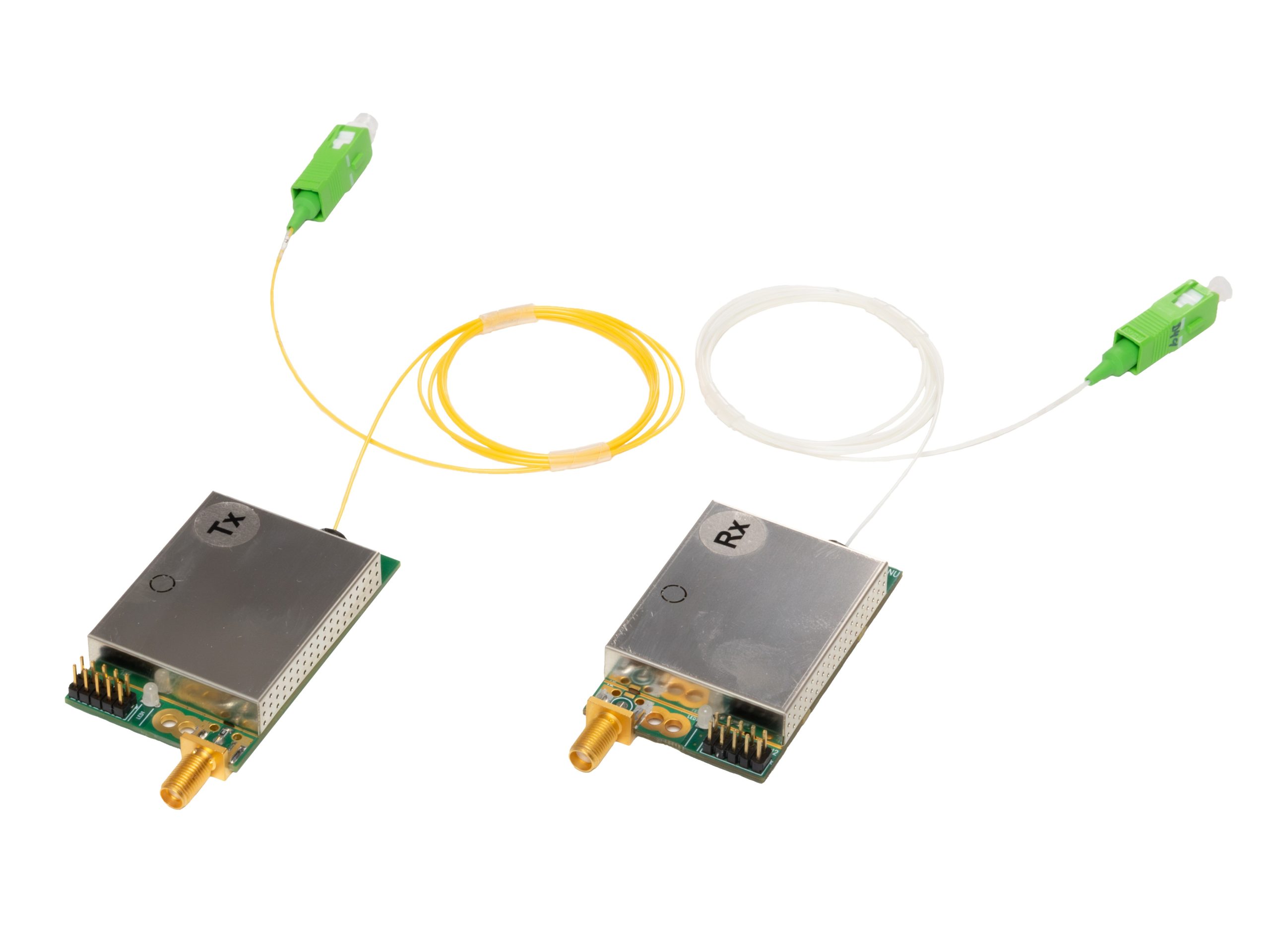
GNSS / GPS over Fiber Tx & Rx Modules
Our modules incorporate the Patented Antenna Status Propagation and enable scalable customized solutions. RF links between GPS antenna(s) and receiver(s) for distances from 100 ft to 5 miles.
Integrators / Single-Link Operators
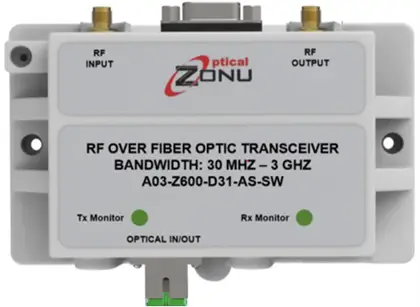
Standalone Modules >>
Compact, cost-effective GNSS / GPS RF-over-fiber link for small sites and Integrators who need fiber components as part of a larger system. Daisy chain drops, splitting and propagating are supported.
Custom Configurations
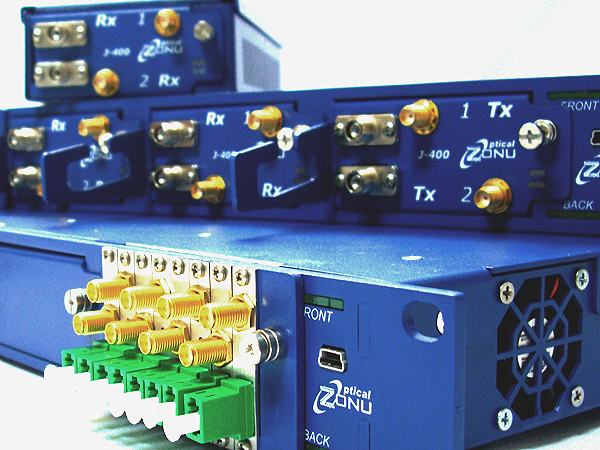
J-Series Modular Fiber System >>
Customizable solution for mixed services applications. Customizable for critical infrastructure.
For board-integrated solutions and developers: 3 Ghz Component >>
More about Optical Zonu’s GNSS / GPS over Fiber Links
Optical Zonu’s GNSS / GPS over Fiber links are designed with the unique, exacting demands of major carriers and power users in mind. That’s why they are, first and foremost, reliable, simple to deploy, and cost-effective.
- Simplicity: The internal LNA preamp of our links ensures the proper RF levels into the fiber link so no adjustments are needed. Plus, an internal bias-T provides the needed DC power for the GNSS / GPS antenna. This means you have an easily installed, drop in replacement, for coaxial cable for any length of cable you may need. We offer antennas when needed.
- Supports Any Architecture: Our GNSS / GPS over Fiber for network links can be optically split or daisy chained to provide a GNSS / GPS Rf signal to multiple locations.
- Signal Purity: Extending a coaxial connection beyond 300 ft and up to 1500 ft requires the use of RF up and down conversion – a process that has the potential for adding phase noise and jitter that would seriously degrade the integrity of the GNSS / GPS signal. The RF-optical conversion process has negligible impact on the GNSS / GPS signal quality making it the reliable choice for any application beyond 300 ft.
- Minimum Added Time Delay: The propagation delay through optical fiber is around 1.7 ns/ft. Other than this, the delay through the fiber optic equipment (transmitter and receiver together) is < 1 ns. These are easily calibrated out with a timing advance entry into the GNSS / GPS receiver.
- Cost-effectiveness: These GNSS / GPS over fiber links and systems are priced to fit the budgets of typical small cell deployments. The simple installation with no adjustments ensures a minimal cost of labor.
- Reliability: Optical Zonu has a large installed base of RF over Fiber systems with a very high record of reliability.
- International GPS Frequencies: Optical Zonu’s GNSS / GPS over fiber links and systems feature broad bandwidth (47 MHz to 2.7 GHz) to ensure support of all signals in the GNSS / GPS band internationally.
- Flexible Architecture can support distribution for up to 128 timing clients from a single antenna.
- Proprietary (Pat. 9,917,638 & 10,257,739): Redundant and reporting solution enable high reliability and easy installation.
GNSS / GPS over Fiber FAQ
What is GPS/GNSS over fiber? Distributing the signals of the location signals from satellite enable longer distance from the antenna. On locations where timing signal is required, e.g. BaseStation, Server Farms, that are either underground or far away from antenna location with sky view the RF signals received from multiple satellites are transported over fiber (RF over Fiber = RFoF). Modern system enable full redundancy, multiple antennas for backup and alternative fiber routes for security.
How does GPS/GNSS over fiber work? The RF signals received from the antennas are converted into optical signal emitted form a laser – transported over single mode or multi-mode fiber – and converter back to RF signal via a Photodetector (PD) that has the proper bandwidth to accommodate signal transport without disruption of the signal to noise ratio.
What are the advantages of GPS/GNSS over fiber? Utilizing RFoF of GPS over fiber (also GNSS over Fiber) enable longer distance from the antenna to the equipment, redundancy, resilience from EMI interference, and multipoint distribution via optical splitting AND RF splitting at the receiver.
Why use fiber instead of coax for GPS/GNSS timing? Coax attenuation impact signal to noise ratio for distances over 10m. GNSS signals are at the approximate frequency of 1.6 GHz – coax distribution is not practical due to the excess attenuation.
Can GPS/GNSS over fiber support long-distance antenna installations? RFoF enable seamless signal transport and splits of kilometers range – basically enable any distance from the antenna to the edge equipment.