

1Optical Zonu Engineering
Application Note AN-001 – 10 minute read
Executive Summary
Modern aircraft maintenance hangars present unique challenges for RF communications. Large steel structures, reinforced concrete, and enclosed maintenance environments can significantly attenuate or completely block GPS/GNSS, satellite, and other radio frequency signals that require direct line-of-sight to outdoor antennas.
These signal limitations can impact aircraft maintenance operations, GPS timing systems, satellite communications terminals, Iridium® satellite devices, avionics testing, and other mission-critical systems that depend on reliable RF connectivity.
RF over Fiber (RFoF) technology provides an effective solution by transporting RF signals from outdoor antennas to indoor equipment over optical fiber with exceptionally low loss, excellent immunity to electromagnetic interference (EMI), and far greater installation flexibility than traditional long coaxial cable runs. Combined with antenna remoting and appropriate indoor distribution techniques, RF over Fiber enables engineers to extend GPS/GNSS, SATCOM, and other satellite-based services into environments where direct satellite visibility is unavailable.
This Engineering Resource Paper examines the RF challenges commonly found in aircraft hangars, explains why conventional approaches often fall short, and demonstrates how RF over Fiber architecture can improve signal availability, system flexibility, and overall infrastructure performance.
✔ Supports GPS/GNSS distribution
✔ Improves indoor satellite coverage
✔ Enables antenna remoting
✔ Ideal for SATCOM infrastructure
✔ Supports Iridium® indoor communications
✔ Excellent for aircraft maintenance hangars
The Engineering Challenge
Aircraft hangars are designed to protect valuable aircraft from weather, simplify maintenance operations, and provide controlled working environments. Ironically, many of the same design characteristics that make hangars ideal for aircraft maintenance also create extremely challenging RF environments.
Large steel support structures, metal roofing systems, reinforced concrete, insulated wall assemblies, and the aircraft themselves can significantly attenuate incoming satellite signals. GPS/GNSS receivers may lose lock, satellite communication terminals may experience reduced performance, and handheld satellite devices such as Iridium® terminals may become unusable once personnel move indoors.
At the same time, today’s aircraft maintenance facilities rely on increasing amounts of RF-dependent technology. Modern maintenance operations frequently require:
- GPS/GNSS timing references
- Satellite communications
- Aircraft avionics testing
- Telemetry systems
- RF monitoring equipment
- Maintenance diagnostics
- Secure communications
- Test instrumentation
Because many of these systems depend on direct line-of-sight to satellites or rooftop antennas, engineers must determine how to deliver reliable RF signals from outdoor antenna locations into large enclosed facilities without degrading signal quality.
Traditional approaches often rely on long coaxial cable runs or standalone repeaters. While these methods may work in some applications, increasing cable lengths introduce additional signal loss, installation complexity, cable weight, and maintenance concerns.
RF over Fiber provides an alternative architecture that transports RF signals over optical fiber while maintaining excellent signal integrity across significantly longer distances. This allows antennas to remain in optimal outdoor locations while delivering RF services wherever they are needed inside the facility.
Why Aircraft Hangars Create RF Challenges
Aircraft hangars are among the most challenging environments for reliable radio frequency (RF) communications. While these facilities are engineered to protect aircraft and provide safe maintenance operations, their construction materials and sheer size often create significant obstacles for wireless and satellite-based communication systems.
Unlike office buildings, hangars typically incorporate large steel support structures, metal wall panels, reinforced concrete, extensive electrical infrastructure, and massive aircraft occupying much of the available floor space. Collectively, these elements can attenuate, reflect, or block RF signals before they reach indoor users or equipment.
Signals requiring direct line-of-sight to satellites are particularly affected. GPS/GNSS receivers, satellite communication terminals, and handheld satellite devices frequently experience degraded performance—or complete loss of connectivity—once moved inside the facility.
As aircraft become increasingly dependent on satellite navigation, precision timing, telemetry, and communications systems, maintaining reliable RF connectivity throughout the maintenance environment has become an increasingly important design consideration.
GPS/GNSS Distribution Inside Aircraft Hangars
Global Positioning System (GPS) and Global Navigation Satellite System (GNSS) signals are widely used for much more than navigation. Modern aviation systems utilize GPS/GNSS for timing synchronization, avionics testing, positioning validation, frequency reference, and numerous maintenance activities.
Unfortunately, GPS signals operate at extremely low power levels when they arrive at the Earth’s surface. Even relatively small obstructions can significantly reduce signal quality.
Aircraft hangars present several challenges for GPS distribution:
• Limited satellite visibility
• Long distances between rooftop antennas and indoor equipment
• Large structural steel components
• Multiple maintenance bays
• Equipment located throughout the facility
• Sensitive electronic environments
To overcome these limitations, many facilities install rooftop GPS/GNSS antennas in locations with unobstructed sky visibility. Rather than relying on long coaxial cable runs to each equipment location, RF over Fiber technology enables engineers to transport these signals over optical fiber with exceptionally low loss.
This architecture allows GPS/GNSS signals to be delivered to timing receivers, avionics test equipment, laboratories, maintenance stations, and other indoor systems while preserving signal integrity over significantly greater distances than traditional coaxial cable installations.The result is a more flexible infrastructure capable of supporting future expansion while minimizing many of the limitations associated with long RF cable runs.Maintaining Satellite Coverage Inside Aircraft Hangars
Maintaining Satellite Coverage Inside Aircraft Hangars
Satellite communication systems present many of the same challenges as GPS/GNSS signals. Whether supporting aircraft communications, maintenance activities, portable terminals, telemetry systems, or other satellite-enabled equipment, these systems depend on reliable reception from satellites located thousands of miles above Earth.
Inside an enclosed aircraft hangar, satellite visibility is often severely restricted.
As maintenance operations increasingly depend on connected systems, engineers require methods to extend satellite services from outdoor antennas into indoor workspaces without compromising overall system performance.
Rather than relocating personnel or equipment outdoors, RF over Fiber technology allows satellite signals to be transported from properly positioned rooftop antennas into maintenance facilities using optical fiber.
Combined with antenna remoting and appropriate indoor RF distribution equipment, this approach can support reliable satellite connectivity throughout maintenance areas while allowing antennas to remain in their optimum outdoor locations.
Typical applications include:
• Aircraft maintenance facilities
• SATCOM testing
• Ground support operations
• Avionics integration
• Communications testing
• Aerospace manufacturing
• Defense maintenance facilities
• Mission planning environments
Supporting Indoor Iridium® Communications
Iridium® satellite communications provide truly global coverage by communicating directly with a constellation of low Earth orbit (LEO) satellites. Because these satellites operate using direct line-of-sight, signal availability may be significantly reduced once users move inside large enclosed facilities such as aircraft hangars.
This presents an operational challenge for maintenance personnel, emergency response teams, defense organizations, and aerospace facilities that depend on satellite communications while working indoors.
Rather than requiring users to leave the building whenever satellite connectivity is needed, outdoor antennas can receive the satellite signal while RF over Fiber transports that signal into the facility.
Appropriate indoor distribution equipment can then make satellite communications available within designated work areas while maintaining the outdoor antenna’s clear view of the satellite constellation.
This approach may benefit applications including:
• Aircraft maintenance operations
• Defense aviation facilities
• Emergency response centers
• Aerospace manufacturing
• Secure communications
• Remote maintenance operations
• Disaster recovery facilities
Although Iridium represents one example of a satellite communication system requiring line-of-sight, the same architectural approach can also support many other RF and satellite-based applications that require reliable indoor signal distribution.
Table 1. Typical aircraft hangar RF challenges and RF over Fiber benefits.
| Application | Typical Challenge | RF over Fiber Benefit |
|---|---|---|
| GPS/GNSS Distribution | Limited sky visibility | Remote antenna placement with low-loss signal transport |
| SATCOM | Building attenuation | Indoor satellite signal distribution |
| Iridium® Communications | Loss of line-of-sight | Indoor satellite connectivity |
| Avionics Testing | Equipment dispersed throughout hangar | Flexible RF distribution architecture |
| Timing Distribution | Long cable distances | Low-loss optical transport |
| Maintenance Operations | Multiple indoor workstations | Centralized outdoor antenna infrastructure |
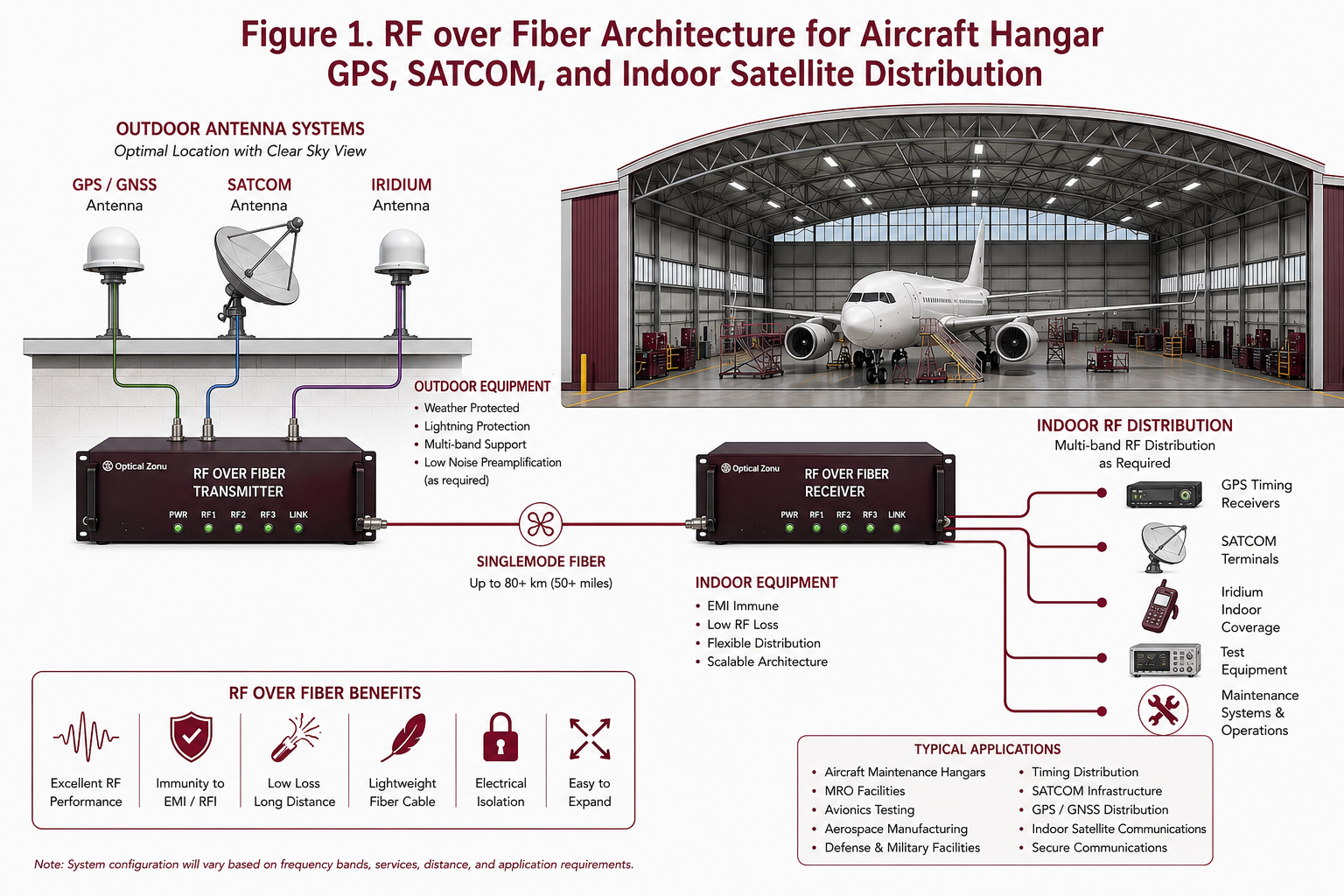
Figure 1. RF over Fiber architecture supporting GPS/GNSS distribution, SATCOM, antenna remoting, and indoor satellite communications within an aircraft maintenance hangar.
Why RF over Fiber Instead of Traditional Coax?
For decades, coaxial cable has been the standard method for transporting RF signals from antennas to receivers, communications equipment, and test systems. In many installations, coax remains a practical and cost-effective solution for relatively short cable runs.
However, aircraft hangars often present requirements that extend well beyond the practical limits of conventional coaxial infrastructure.
Large maintenance facilities may span hundreds of feet, requiring antennas to be installed on rooftops or towers while equipment is located deep inside the building. As cable length increases, engineers must account for signal attenuation, installation complexity, cable weight, grounding considerations, and future expansion requirements.
RF over Fiber addresses many of these challenges by converting RF signals into optical signals for transport over fiber optic cable before converting them back to RF at the receiving location.
Because optical fiber exhibits extremely low attenuation over long distances while remaining immune to electromagnetic interference (EMI), RF over Fiber provides a flexible architecture for transporting RF signals throughout large aerospace facilities.
Rather than designing around the limitations of long coaxial cable runs, engineers can optimize antenna placement for signal reception while locating users and equipment wherever operational requirements dictate.
Table 2. RF over Fiber compared with traditional coaxial cable infrastructure.
| Design Consideration | Traditional Coax | RF over Fiber |
|---|---|---|
| Long-distance RF transport | Signal loss increases with distance | Excellent long-distance performance |
| EMI susceptibility | Can be affected | Immune to EMI |
| Cable weight | Heavy | Lightweight optical fiber |
| Installation flexibility | Moderate | Excellent |
| Future expansion | Limited | Easily scalable |
| Electrical isolation | Requires careful grounding | Naturally isolated |
| Multiple indoor locations | More complex | Easily distributed |
| Rooftop antenna placement | Distance limitations | Ideal for remote antenna architectures |
Design Considerations
Every aircraft hangar presents unique operational requirements, making proper system design critical to long-term performance.
Several engineering factors should be evaluated when designing an RF distribution system, including:
• Required RF frequency range
• GPS/GNSS signal requirements
• Satellite communication services
• Number of indoor coverage areas
• Distance between antennas and equipment
• Fiber routing options
• Optical loss budget
• Environmental conditions
• Redundancy requirements
• Future expansion plans
• Existing infrastructure
• Electromagnetic interference (EMI)
• Power availability
Rather than viewing RF transport as simply extending an antenna cable, engineers should consider the entire signal path—from satellite reception through indoor distribution—to ensure reliable performance across all connected systems.
An architecture designed around RF over Fiber often provides significantly greater flexibility for future growth, equipment relocation, and facility expansion.
Typical Applications
Although aircraft maintenance hangars provide an excellent example of RF distribution challenges, the same engineering principles apply across many industries.
Typical applications include:
• Commercial aircraft maintenance facilities
• Military aircraft shelters
• Aerospace manufacturing plants
• MRO (Maintenance, Repair and Overhaul) facilities
• Aircraft integration laboratories
• Defense communication facilities
• Satellite ground stations
• Command and control centers
• Emergency operations centers
• Transportation infrastructure
• Industrial manufacturing facilities
• Large warehouses
• Secure government facilities
• Research laboratories
In each of these environments, RF over Fiber enables antennas to remain in optimal outdoor locations while distributing RF services to equipment and personnel located throughout the facility.
Optical Zonu RF over Fiber Solutions
Optical Zonu has extensive experience designing RF over Fiber solutions that transport critical RF signals over optical fiber for aerospace, defense, satellite communications, wireless infrastructure, timing distribution, and other demanding applications.
By combining RF over Fiber technology with antenna remoting and indoor RF distribution, Optical Zonu solutions help organizations extend GPS/GNSS, satellite communications, timing signals, and other RF services throughout large facilities while allowing antennas to remain in locations that provide optimal signal reception.
Whether supporting aircraft maintenance hangars, defense facilities, aerospace manufacturing, or mission-critical communications infrastructure, RF over Fiber provides engineers with a flexible architecture capable of adapting to changing operational requirements.
Applications may include:
• GPS/GNSS distribution
• Timing distribution
• SATCOM infrastructure
• Indoor satellite communications
• Antenna remoting
• Iridium® indoor coverage
• RF monitoring systems
• Test and measurement
• Aerospace communications
• Defense communications
Because every facility presents unique operational requirements, Optical Zonu works with customers to evaluate antenna placement, link distances, RF frequency ranges, optical loss budgets, environmental conditions, redundancy requirements, and future expansion plans before recommending an appropriate RF over Fiber architecture.
Conclusion
Aircraft hangars present some of the most demanding RF environments found in commercial and defense aerospace facilities. Large steel structures, enclosed workspaces, and increasing dependence on GPS/GNSS, satellite communications, and timing systems require engineers to carefully consider how RF signals are transported throughout the facility.
While traditional coaxial cable remains appropriate for many short-distance applications, larger maintenance facilities frequently benefit from RF over Fiber architectures that provide greater installation flexibility, lower signal loss over long distances, improved immunity to electromagnetic interference, and simplified support for future expansion.
By combining rooftop antenna installations, RF over Fiber transport, antenna remoting, and indoor RF distribution, organizations can improve access to GPS/GNSS signals, satellite communications, timing infrastructure, and other RF services throughout aircraft maintenance environments.
As aerospace systems continue to evolve, flexible RF infrastructure will play an increasingly important role in supporting efficient maintenance operations, advanced communications, and mission-critical engineering activities.
Related Engineering Resource Papers
GPS Signal Testing for GPS/GNSS Over Fiber and Timing Distribution
RF over Fiber for Naval and Submarine Applications
Antenna Remoting for SATCOM, NTN, and Direct-to-Device
Timing Distribution Using RF over Fiber
Frequently Asked Questions
Why do GPS signals stop working inside aircraft hangars?
Large steel structures, metal roofing, reinforced concrete, and enclosed workspaces can significantly attenuate GPS/GNSS signals, reducing or preventing reliable reception inside aircraft maintenance facilities.
How can GPS signals be distributed inside a hangar?
A rooftop antenna combined with RF over Fiber technology can transport GPS/GNSS signals over optical fiber to indoor receivers, timing equipment, and maintenance systems while maintaining signal integrity over long distances.
Why use RF over Fiber instead of long coax?
RF over Fiber provides lower signal loss over long distances, immunity to electromagnetic interference, lighter cabling, and greater flexibility for expanding RF infrastructure throughout large facilities.
Can Iridium® devices operate inside aircraft hangars?
Because Iridium communications require line-of-sight to satellites, indoor coverage can be challenging. Outdoor antennas combined with RF over Fiber and appropriate indoor distribution equipment can extend satellite connectivity into designated work areas.
What applications benefit from RF over Fiber in aircraft hangars?
Typical applications include GPS/GNSS distribution, timing systems, SATCOM, avionics testing, RF monitoring, maintenance operations, aerospace manufacturing, defense communications, and indoor satellite communications.
Need Help Designing an RF over Fiber Solution?
Our engineering team can help evaluate:
• GPS/GNSS Distribution
• SATCOM Infrastructure
• Antenna Remoting
• Timing Distribution
• RF Architecture
• Indoor Satellite Coverage
Contact us to discuss your application.
[email protected]