

What is RF over Fiber?
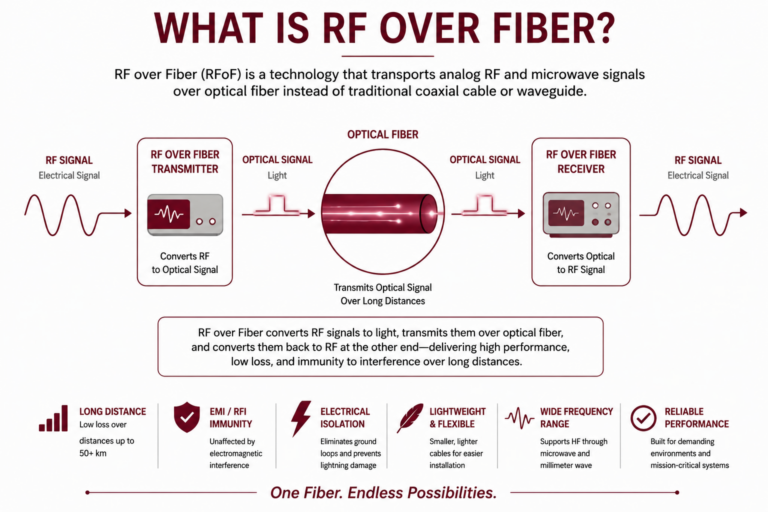
RF over Fiber (RFoF) is a technology that transports analog radio frequency (RF) and microwave signals over optical fiber instead of traditional coaxial cable or waveguide. Rather than transmitting electrical signals through conductive media, RF over Fiber converts RF energy into optical signals for transmission over fiber optic cable before converting them back into RF at the receiving end.
This approach enables engineers to transport high-frequency signals over distances ranging from a few meters to more than 50 kilometers while maintaining outstanding signal quality and dramatically reducing many of the limitations associated with conventional RF transmission methods.
Compared to coaxial cable, RF over Fiber offers several important advantages:
- Extremely low signal loss over long distances
- Immunity to electromagnetic interference (EMI) and radio frequency interference (RFI)
- Complete electrical isolation that eliminates ground loops and lightning concerns
- Reduced cable weight and simplified installation
- Support for frequencies from HF through millimeter wave applications
- Improved reliability in harsh industrial, aerospace, defense, and telecommunications environments
These advantages have made RF over Fiber the preferred transport technology for many demanding applications where signal integrity, distance, reliability, and system performance are critical.
As wireless systems continue migrating toward higher frequencies—including 5G, satellite communications, phased-array radar, electronic warfare, and advanced aerospace systems—the benefits of RF over Fiber become even more significant.