

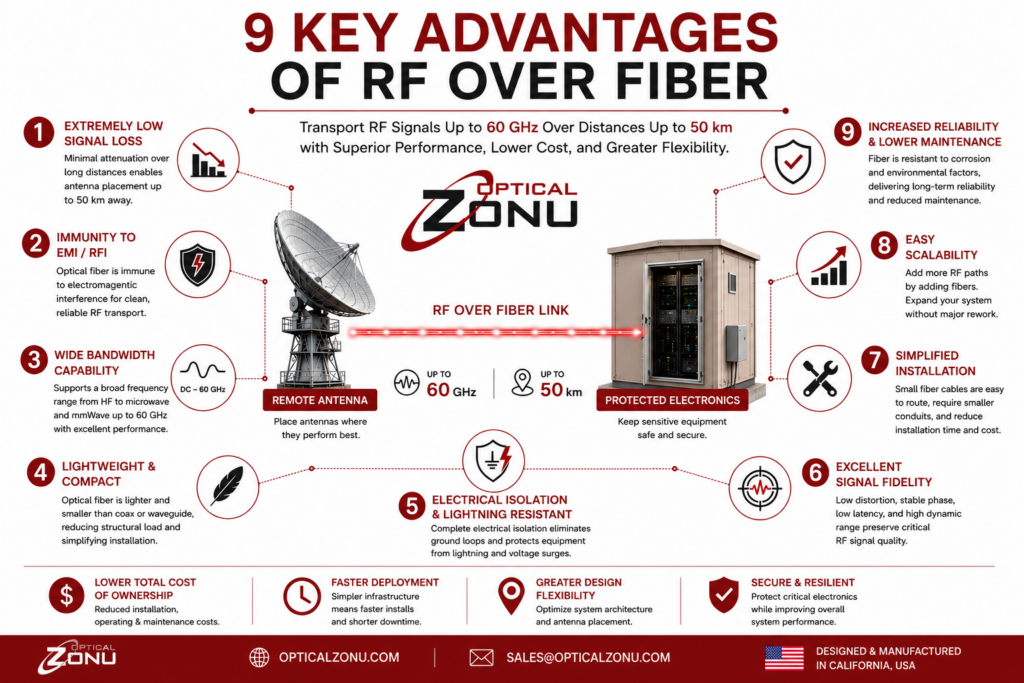
As RF systems become more complex and frequencies continue to increase, traditional transmission methods such as coaxial cable and waveguide often become limiting factors. Signal loss, weight, installation complexity, and distance limitations can all impact overall system performance.
RF over Fiber (RFoF) technology addresses these challenges by transporting analog RF signals over optical fiber while maintaining excellent signal integrity. The result is greater installation flexibility, improved performance, and lower infrastructure costs across a wide range of commercial, telecommunications, aerospace, and defense applications.
Whether supporting antenna remoting, satellite communications, radar systems, or distributed antenna networks, RF over Fiber offers numerous advantages over conventional RF transport methods.
Key Advantages of RF over Fiber
Extremely Low Signal Loss Over Long Distances
One of the most significant benefits of RF over Fiber is its ability to transport RF signals over extremely long distances with minimal attenuation.
While coaxial cable losses increase rapidly with frequency and cable length, optical fiber experiences exceptionally low loss, allowing RF signals to be transported over distances of up to 50 km without the performance limitations associated with traditional RF cabling.
This enables engineers to place antennas where they perform best rather than where coaxial cable limitations allow.
Immunity to Electromagnetic Interference (EMI/RFI)
Unlike copper cable, optical fiber is completely immune to electromagnetic interference (EMI) and radio frequency interference (RFI).
This makes RF over Fiber ideal for electrically noisy environments including:
- Military installations
- Industrial facilities
- Airports
- Broadcast sites
- Teleport facilities
- High-power RF environments
Signal integrity remains consistent regardless of nearby electrical equipment or RF emissions.
Wide Bandwidth Capability
Modern RF over Fiber systems support an exceptionally wide RF frequency range.
Optical Zonu’s solutions transport RF signals from low frequencies through microwave frequencies up to 60 GHz, making them suitable for:
- Radar
- Electronic Warfare (EW)
- SATCOM
- 5G Networks
- Test & Measurement
- Aerospace applications
As higher-frequency applications continue to emerge, RF over Fiber provides an infrastructure ready for future expansion.
Lightweight and Compact Infrastructure
Replacing large-diameter coaxial cable or rigid waveguide with lightweight optical fiber significantly simplifies installation.
Benefits include:
- Smaller conduit requirements
- Easier routing
- Reduced structural loading
- Lower shipping costs
- Faster installation
For large facilities and remote antenna installations, these advantages can dramatically reduce project complexity.
Electrical Isolation and Lightning Protection
Because optical fiber contains no conductive metal, RF over Fiber naturally provides complete electrical isolation.
Benefits include:
- Elimination of ground loops
- Protection from lightning-induced currents
- Improved personnel safety
- Reduced equipment damage
- Isolation between buildings and remote antenna sites
This added protection is especially valuable for outdoor and long-distance deployments.
Excellent Signal Fidelity
RF over Fiber systems are designed to preserve the integrity of analog RF signals.
Key performance characteristics include:
- Low distortion
- Excellent dynamic range
- Stable phase performance
- Low latency
- High signal fidelity
These characteristics are essential for demanding applications where signal quality directly impacts system performance.
Simplified Installation and Lower Infrastructure Costs
Traditional coaxial cable and waveguide installations often require:
- Large coaxial cable
- Heavy waveguide
- RF amplifiers
- Complex routing
- Specialized mounting hardware
RF over Fiber reduces many of these requirements by allowing lightweight fiber to carry RF signals over long distances.
This often results in:
- Lower installation costs
- Faster deployment
- Simplified maintenance
- Greater installation flexibility
Easy Scalability
As systems grow, RF over Fiber infrastructure is easy to expand.
Adding additional RF paths typically requires only additional fiber strands rather than replacing heavy coaxial cable runs.
This flexibility makes RF over Fiber well suited for facilities expected to expand over time.
Increased Reliability and Reduced Maintenance
Optical fiber is resistant to corrosion, moisture, and many environmental factors that can affect traditional RF transmission media.
Combined with fewer active components in many installations, RF over Fiber systems often deliver:
- Improved long-term reliability
- Reduced maintenance
- Lower operating costs
- Increased system uptime
Real-World Applications
RF over Fiber technology is widely deployed across numerous industries, including:
- Satellite Communications (SATCOM)
- Teleport Facilities
- Antenna Remoting
- Electronic Warfare (EW)
- Radar Systems
- Military Communications
- Aerospace
- Distributed Antenna Systems (DAS)
- Broadcast Networks
- Test & Measurement Laboratories
Each of these applications benefits from RF over Fiber’s ability to transport high-frequency RF signals over long distances while maintaining exceptional signal quality.
Why These Advantages Matter
The following comparison highlights why RF over Fiber has become the preferred choice for many modern RF transport applications
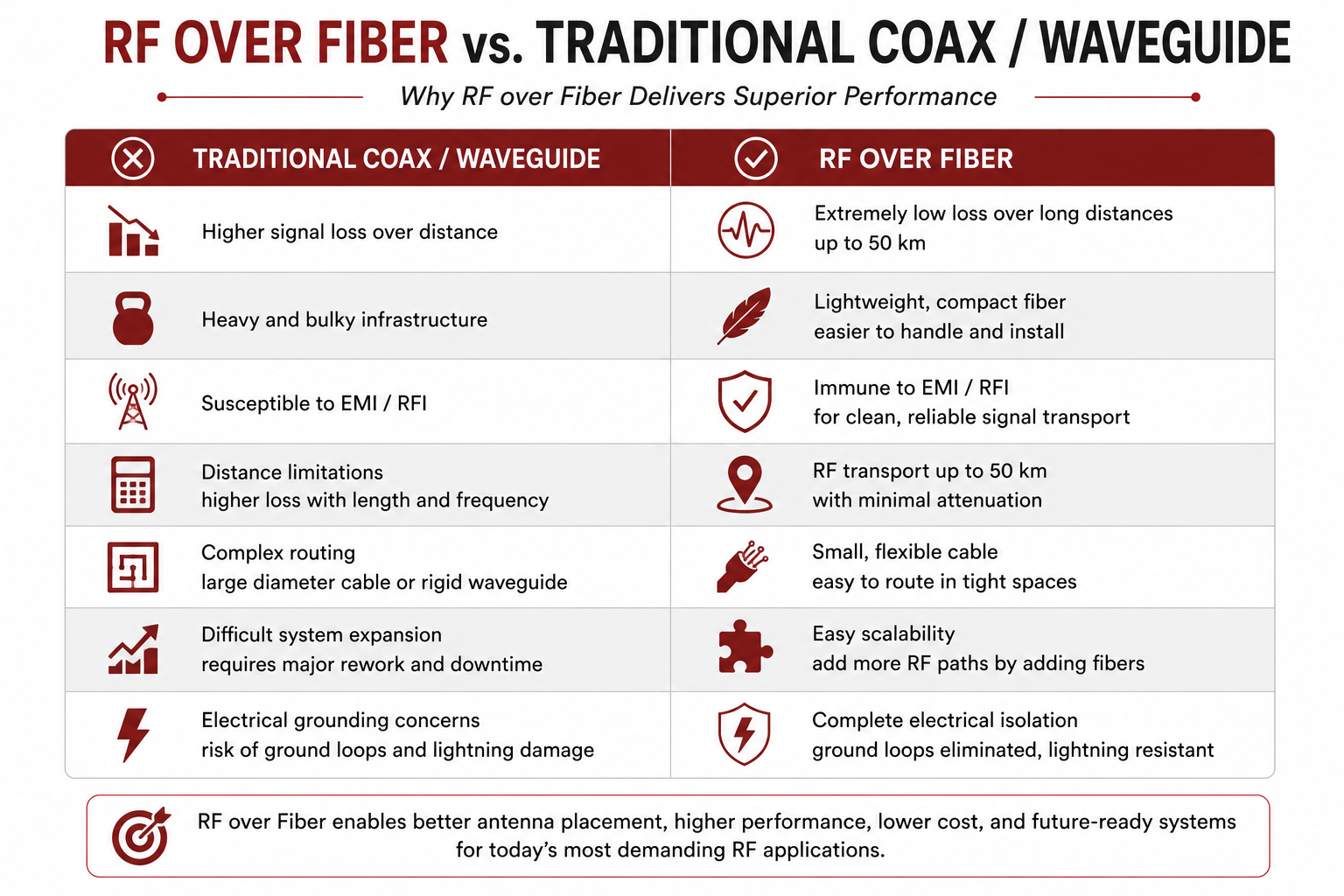
Rather than simply replacing coaxial cable, RF over Fiber enables engineers to rethink overall system architecture. Antennas can be positioned where they deliver the best performance while sensitive electronics remain protected in secure or environmentally controlled locations.
Conclusion
RF over Fiber offers far more than an alternative method of transporting RF signals. It provides engineers with greater flexibility, improved performance, reduced infrastructure costs, and a scalable foundation for future RF system expansion.
As communication, radar, aerospace, and defense systems continue to evolve, RF over Fiber has become an increasingly important technology for organizations seeking reliable, high-performance RF transport over long distances.