

How RF over Fiber Works
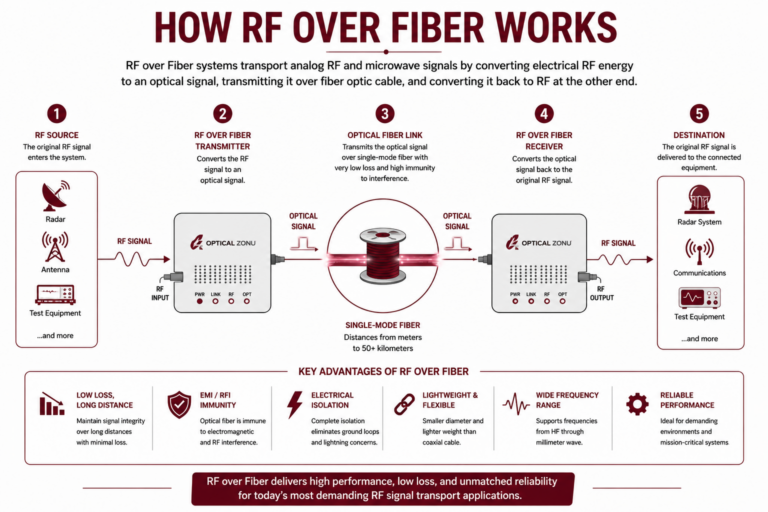
RF over Fiber systems transport analog RF and microwave signals by converting electrical RF energy into an optical signal, transmitting that signal over fiber optic cable, and then converting it back into its original RF form at the receiving end. This process allows engineers to overcome many of the distance, loss, and interference limitations associated with traditional coaxial cable and waveguide.
A typical RF over Fiber system consists of three primary components:
RF Input
The original RF signal enters the transmitter from a radar system, antenna, communications system, test equipment, or other RF source.
Optical Transmission
The RF signal is converted into an optical signal and transmitted over single-mode fiber. Because optical fiber exhibits extremely low attenuation and is immune to electromagnetic interference (EMI) and radio frequency interference (RFI), signal integrity can be maintained over distances that would be impractical using coaxial cable.
RF Output
At the receiving end, the optical signal is converted back into its original RF format with high fidelity, allowing the connected equipment to receive the same signal with minimal degradation.
This architecture provides numerous performance advantages over traditional RF transport methods, including:
- Long-distance RF signal transport with minimal loss
- Immunity to EMI and RFI
- Complete electrical isolation
- Elimination of ground loops
- Reduced cable weight and installation complexity
- Reliable operation in harsh environments
- Support for frequencies from HF through millimeter-wave applications
These capabilities make RF over Fiber an ideal solution for aerospace and defense, radar systems, satellite communications (SATCOM), telecommunications, distributed antenna systems (DAS), GPS synchronization, electronic warfare, and high-performance test and measurement applications.