

RF over Fiber vs. Coaxial Cable
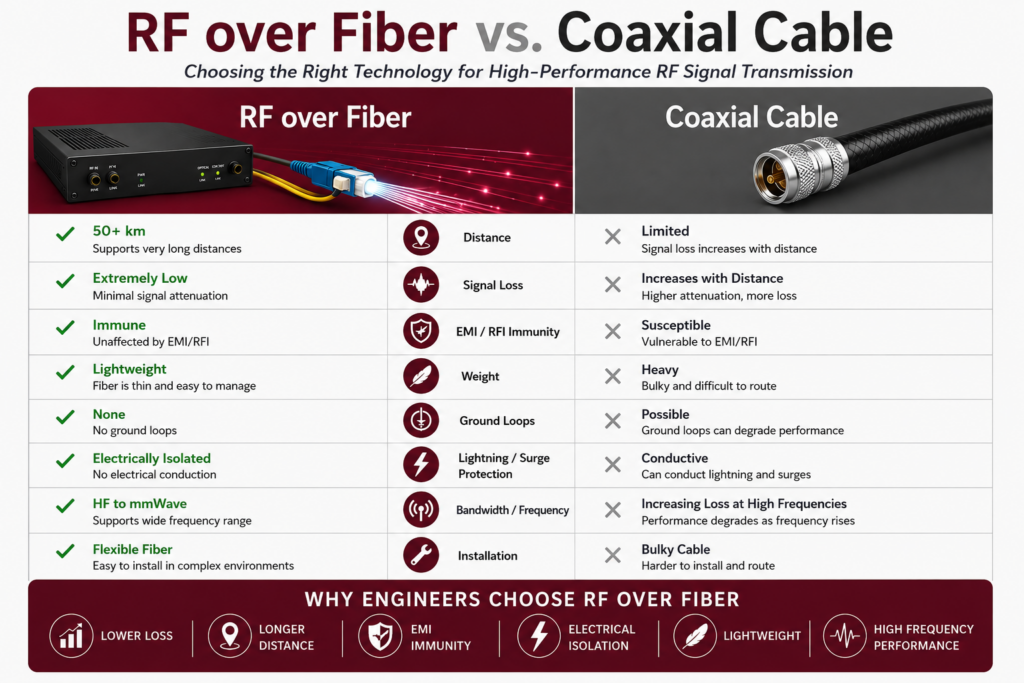
RF over Fiber vs. Coaxial Cable: Which Technology Is Right for Your Application?
One of the most common questions engineers ask when designing high-frequency communication systems is whether traditional coaxial cable remains the best solution for transporting RF signals or whether RF over Fiber offers meaningful performance advantages.
For decades, coaxial cable has been the standard for RF signal transmission. It is well understood, readily available, and performs well over relatively short distances. However, as operating frequencies continue to increase and systems require longer transmission distances, many of the inherent limitations of coaxial cable become more pronounced.
RF over Fiber addresses many of these limitations by converting RF signals into optical signals for transmission over fiber optic cable before converting them back to RF at the receiving end. This approach dramatically reduces signal loss, eliminates susceptibility to electromagnetic interference (EMI), provides complete electrical isolation, and enables RF transport over distances exceeding 50 kilometers.
Signal Loss
One of the primary limitations of coaxial cable is attenuation. As cable length and operating frequency increase, signal loss increases significantly, often requiring additional amplification or limiting overall system performance.
RF over Fiber, by comparison, exhibits extremely low attenuation over long distances, making it well suited for distributed antenna systems, radar installations, satellite communications, and telecommunications networks.
Electromagnetic Interference
Because coaxial cable carries electrical signals, it remains susceptible to electromagnetic interference (EMI) and radio frequency interference (RFI), particularly in electrically noisy environments.
Fiber optic cable is immune to EMI and RFI, helping preserve signal integrity in demanding industrial, aerospace, and defense applications.
Distance
While coaxial cable performs well over shorter runs, RF over Fiber is specifically designed for long-distance RF transport. Many RF over Fiber systems support transmission distances greater than 50 kilometers while maintaining outstanding signal quality.
Weight and Installation
Fiber optic cable is substantially lighter than comparable coaxial cable and is easier to route through complex installations. This can reduce installation costs and simplify infrastructure in aerospace, defense, and telecommunications deployments.
Electrical Isolation
Unlike coaxial cable, fiber optic cable provides complete electrical isolation, eliminating ground loops and reducing lightning-related risks in outdoor installations.
Which Technology Should You Choose?
For short cable runs and conventional RF applications, coaxial cable remains a practical solution.
However, for long-distance transmission, high-frequency operation, EMI immunity, electrical isolation, and mission-critical performance, RF over Fiber provides significant advantages that continue to drive adoption across aerospace, defense, telecommunications, satellite communications, and distributed antenna systems.