
OZC Solution:
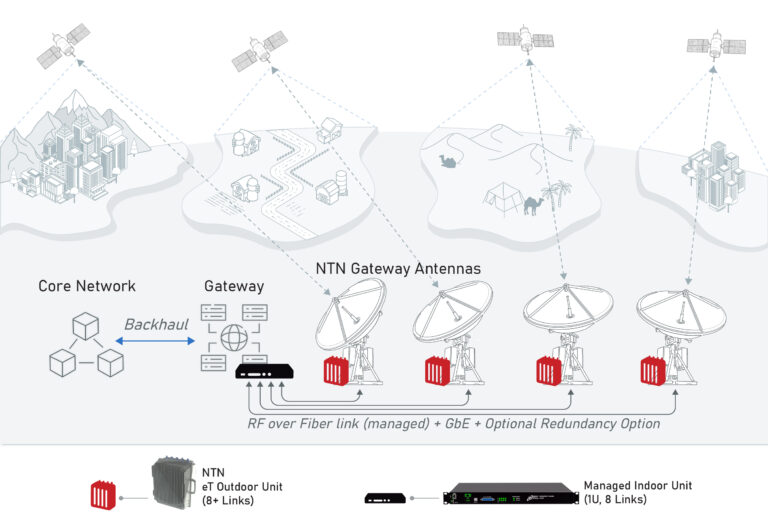
Optical Zonu provided an eFiberSat RF over Fiber transport architecture designed for high-performance satellite feeder-line signal transport. The system used a dual-polarization, redundant fiber architecture to support end-to-end multi-channel transport for the customer’s ground station environment.
Unlike bandwidth-constrained digital or packetized IF approaches, the Optical Zonu RFoF architecture provides broadband analog RF transport across sub-6 GHz operating frequencies. This allows complex wideband and multi-carrier signals to be transported without requiring narrow frequency-specific hardware changes or restrictive filtering for each operating band.
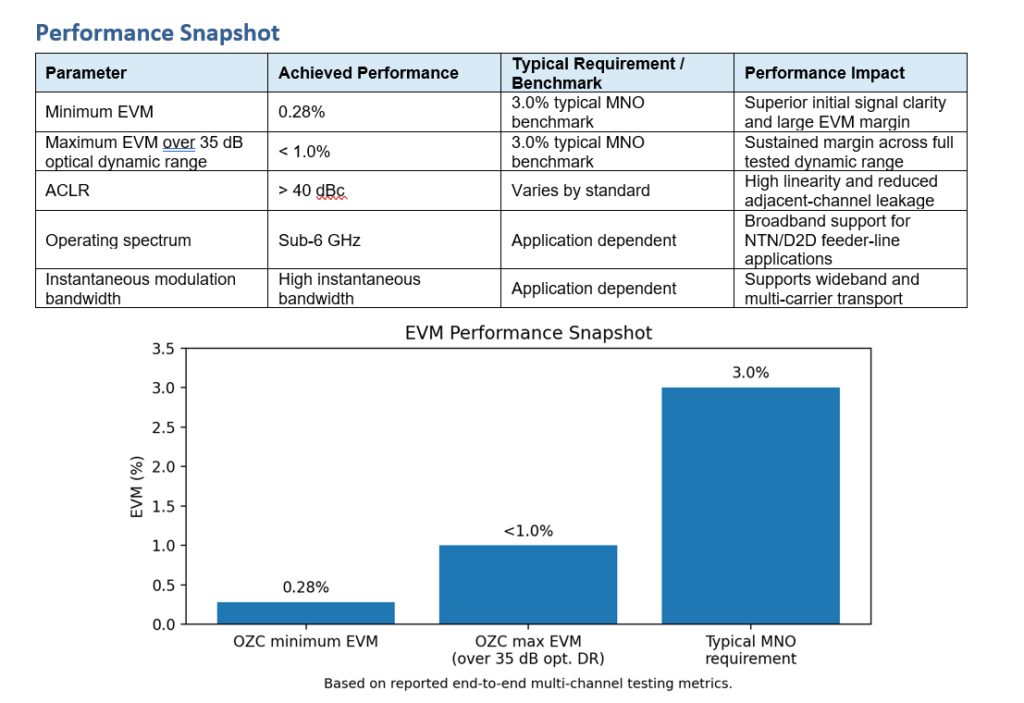
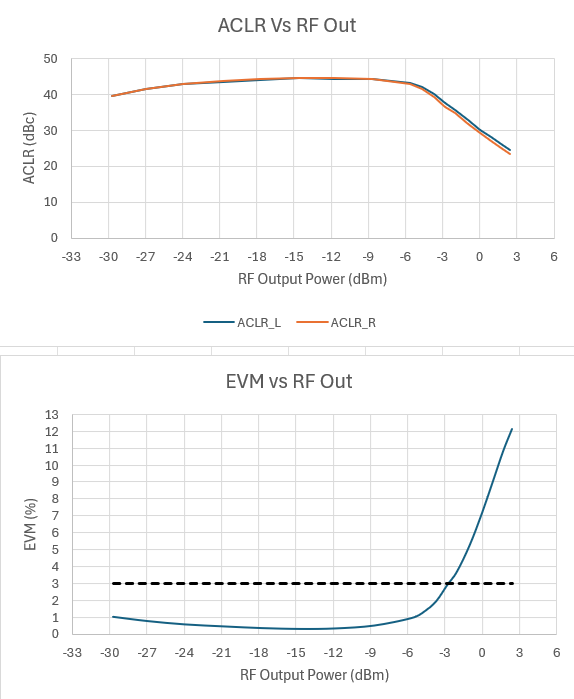
The solution delivered extremely low EVM contribution and high ACLR to the overall system, allowing the customer to preserve margin for other components in the signal chain. By contributing less than 1.0% EVM across a 35 dB optical dynamic range, the Optical Zonu transport system helped improve overall signal quality and reduce integration constraints in the larger NTN/D2D satellite ground station system.
Optical Zonu Products Used:
- Optical Zonu eFiberSat RF over Fiber transport system
- Dual-polarization redundant fiber transport architecture
- Sub-6 GHz broadband RFoF feeder-line transport links
- Custom system-level RFoF engineering support for satellite ground station integration
- Managed RFoF is a suite of tools and applications used to monitor/control local and geographically dispersed signal transport systems. Only a standard web browser is required to connect to an embedded Managed RFoF agent. SNMP v2/v3 enables all user interfaces. A System level remote monitoring and management system SNMP
Results / Outcomes
- Reported minimum EVM of 0.28%, significantly below the typical 3.0% MNO requirement.
- Maintained less than 1.0% EVM across a 35 dB optical dynamic range.
- Delivered approximately 2.0% or more EVM margin across the tested dynamic range, helping preserve system-level performance margin.
- Achieved greater than 40 dBc ACLR, supporting spectral purity and reducing adjacent-channel interference risk.
- Supported high instantaneous modulation bandwidth across sub-6 GHz operating frequencies.
- Improved integration flexibility for multi-channel feeder-line transport in a satellite ground station environment.
- Helped ease downstream deployment constraints by reducing the RFoF transport system’s contribution to the total allowed EVM budget.