

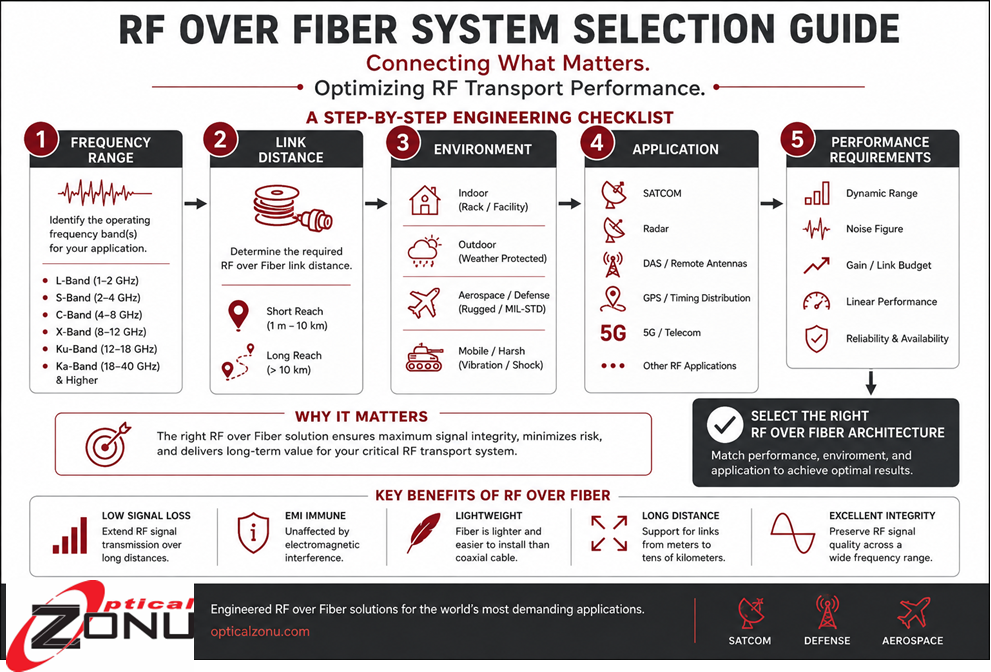
As RF systems continue expanding into higher frequencies, longer transmission distances, and more distributed architectures, engineers are increasingly turning to RF over Fiber technology to overcome the limitations of traditional coaxial cable.
Whether you’re designing a satellite communications network, remote antenna system, radar installation, or aerospace application, selecting the proper RF over Fiber solution can have a significant impact on system performance, reliability, and long-term scalability.
This guide outlines the key factors engineers should consider when evaluating an RF over Fiber system.
Why Engineers Choose RF over Fiber
Traditional coaxial cable works well for short distances, but performance begins to degrade as cable lengths increase, especially at higher frequencies.
RF over Fiber addresses these limitations by transporting RF signals over optical fiber, providing:
- Extremely low signal loss
- Immunity to electromagnetic interference (EMI)
- Lightweight infrastructure
- Long-distance transmission
- Excellent signal integrity
- Simplified remote antenna deployment
These advantages have made RF over Fiber the preferred transport technology for many modern communications systems.
RF over Fiber vs. RF over Optical
Engineers often encounter the terms RF over Fiber and RF over Optical.
While different manufacturers may use different terminology, both describe the same fundamental technology: converting RF signals into optical signals for transmission over fiber optic cable before converting them back to RF at the receiving end.
Understanding this terminology helps when comparing products from different suppliers.
Choosing the Right RF over Fiber Converter or Transceiver
Not all RF over Fiber systems are designed for the same application.
When evaluating an RF over Fiber converter or RF over Fiber transceiver, engineers should consider several critical specifications.
Frequency Range
Ensure the link supports the entire operating frequency of your application.
Dynamic Range
Higher dynamic range improves overall signal fidelity while minimizing distortion.
Link Gain
System gain should match the requirements of the RF architecture.
Noise Figure
Lower noise figures improve weak signal performance and overall system sensitivity.
Environmental Requirements
Outdoor, aerospace, defense, and industrial environments may require ruggedized housings, extended temperature operation, or sealed enclosures.
Typical RF over Fiber Applications
RF over Fiber technology supports a wide variety of applications, including:
- Satellite Communications (SATCOM)
- Distributed Antenna Systems (DAS)
- Aerospace & Defense
- Radar Systems
- Electronic Warfare
- GPS Timing Distribution
- Broadcast Networks
- Remote Antenna Systems
- Scientific Research
- Telecommunications Infrastructure
Each application presents different design challenges, making proper system selection essential.
Planning for Future Expansion
One advantage often overlooked during system design is scalability.
Choosing modular RF over Fiber equipment allows engineers to expand capacity as system requirements grow while preserving the existing fiber infrastructure.
This flexibility can reduce long-term costs while simplifying future upgrades.
Why Experience Matters
Although RF over Fiber products may appear similar on paper, differences in engineering design, customization options, frequency support, and technical expertise can significantly affect system performance.
Working with an experienced RF over Fiber manufacturer helps ensure the selected solution meets both current operational requirements and future expansion needs.
Continue Learning About RF over Fiber
If you’re beginning your evaluation of RF over Fiber technology, these additional resources may be helpful:
- What is RF over Fiber?
- How RF over Fiber Works
- RF over Fiber in Aerospace & Defense Applications
- Miniature Ku-Band RF over Fiber Solutions
These resources provide additional technical information to help engineers design reliable RF transport systems.