

Tactical Radio - RF over Fiber
Optical Zonu offers a variety of electrical-to-optical building blocks that may be integrated into tactical radio systems to extend radio to antenna separation to distances that are both convenient and safe for radio operators. Tactical systems generally are specialized radios that are designed for military or law enforcement use, built to withstand harsh conditions and provide secure communication in critical situations on the battlefield, often featuring encryption and advanced capabilities to minimize enemy interception and interference; essentially, a ruggedized radio built to military specifications for reliable communication in demanding environments.
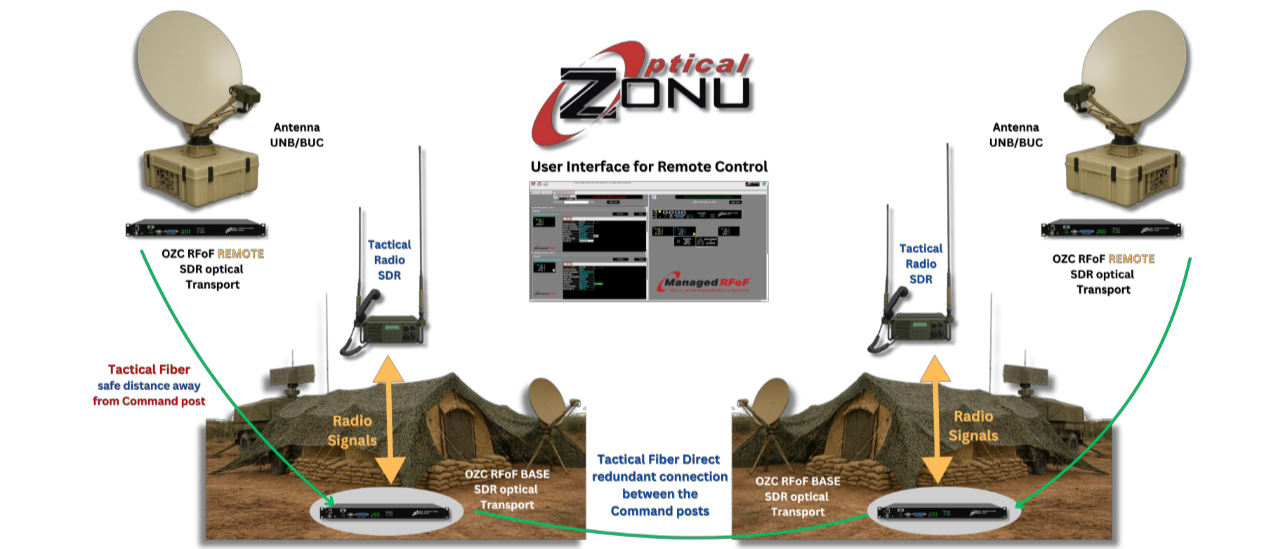
- Use OZC’s RFoF to separate mesh radio units from their high-mounted antennas.
- Critical in EMCON-sensitive operations, improving both safety and signature management.
- Multi-Radio Co-Site Isolation
- When TrellisWare, Persistent Systems, or Silvus radios are co-located with other emitters (e.g., SATCOM, SINCGARS, EW), RFoF provides RF isolation and minimizes intermodulation/interference.
- See Tactical Radio page for more information.
eFiberSAT and RF over Fiber
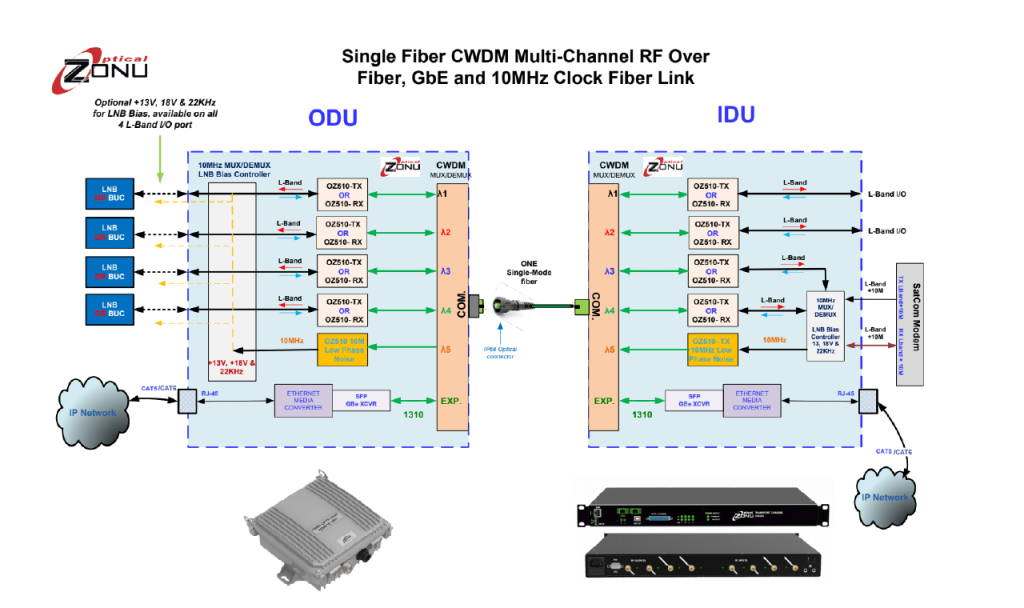
- Infrastructure cabling can take the most convenient path due to the fact of the low loss, EMI/RFI immunity of fiber optic cabling
- High capacity functionality architecture
- In many application systems are used for military applications. The fiber interface allows for safe operation of the equipment at a safe distance in hostile environments
- The architecture shown in figure 1 shows a typical bidirectional eFiberSAT system. This equipment can support fixed stations, ground deployments, campuses, mining/offshore and building requirements. These scenarios create a challenge for traditional systems. RF over Fiber based eFiberSAT systems can be deployed to provide the necessary coverage with minimal effort
- Easy installation using only single strand of fiber, for simple plug-play set up
- Low maintenance
The challenge for many networks has always been the limited reach the RF cabling. This is due the location of the Antenna Sin respect to Network Operating Center (NOC) doesn’t always coincide with the limitations of coaxial cable. In many instances to support the coaxial limitations extensive building modifications are required. When using a fiber based eFiberSAT system the following issues are eliminated:
Antenna Remoting Solutions from Optical Zonu offer the Following Advantages.
- Transport of any L-, C-, X-, Ku-, K-, Ka-, Q-, and V-band RF signals over fiber
- Bi-directional RF signal transport from 10 kHz to 70 GHz (e.g reference clock and bi-directional signals)
- Low transport attenuation loss – fiber (0.7 dB/km), RG 0.25” coaxial cable (1.2 dB/meter at 15 GHz)
- Highly linear operation, SFDR > 110 dB-Hz
- OZC patented, fast fiber fault finding technology (uOTDR) to monitor fiber integrity and locate defects
- Pluggable Field Replaceable Modules
- N+1 Redundancy protection of fiber(s), transmitter(s), receiver(s)
- SNMP v2 & v3 and or RESTful API – Managed RFoF management and control interface
- OZC web graphical user interface (GUI) and embedded NMS application
- As Optical Fiber does not Radiate RF, Signal Detection and Interception are Greatly Reduced
- Optical fiber is immune to virtually all types of interference (including lightning)
- Optical fiber will not conduct electricity or create ground loops
- There is no possibility of a spark from a broken fiber, therefore no electrical shock or fire hazard
- As fiber is glass, it is unaffected by most corrosive chemicals and moisture
- Fiber is lightweight and flexible, cable and waveguide are heavy and bulky

Antenna Remoting over fiber enables greater flexibility to locate an antenna away from a radio head. Coax cables or Waveguides have significant RF losses and are cumbersome to install. RF over Fiber enables “virtual cable” installation over flexible, small diameter, easily deployed and installed fiber. Such an Antenna Remoting solution was deployed, tested, and validated by the US Navy.
Antenna Remoting over fiber enables greater flexibility to locate an antenna away from a radio head. Coax cables or Waveguides have significant RF losses and are cumbersome to install. RF over Fiber enables “virtual cable” installation over flexible, small diameter, easily deployed and installed fiber. Such an Antenna Remoting solution was deployed, tested, and validated by the US Navy
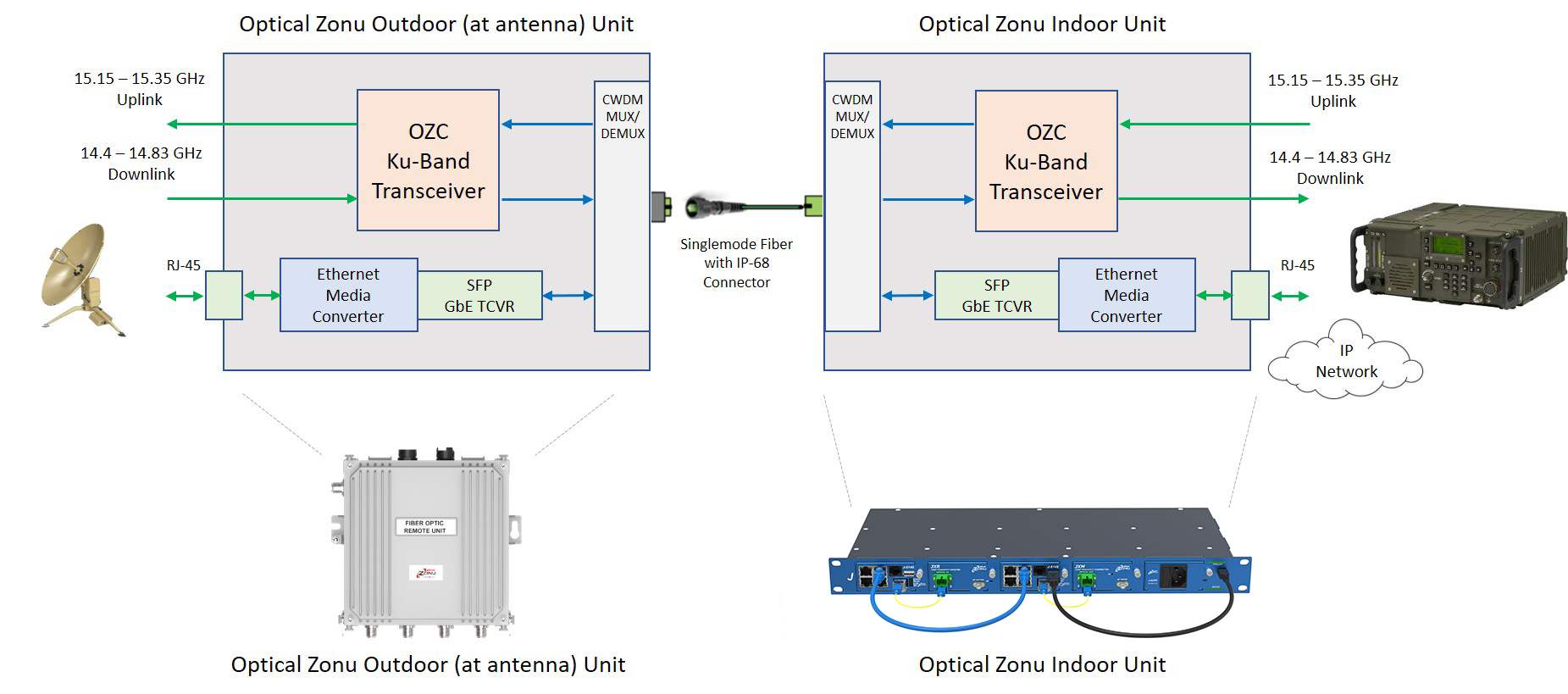
The Common Data Link (CDL) is a secure communications protocol, established by the U.S. Department of Defense, for transporting signals intelligence and imagery. CDL supports data rates up to 274 Mbits/s and operates between sites (e.g., airborne, shipboard, ground, satellite) in the Ku-band. In many cases, it is not feasible to upconvert/downconvert the Ku-band signals at an antenna. Optical Zonu’s CDL fiberoptic transport links solve the problem and meet the requirement of transporting Ku-band RF signals over much longer distances than can be supported by copper. Optical Zonu CDL deployments include lightweight antenna remoting kits for tactical deployment in flexible arenas such as the battlefield of the future. Optical Zonu CDL links also support Ku-band connectivity between remote antenna radome high above the decks of ships and Satcom modems deep within fighting ships. Optical Zonu CDL fiberoptic links meet and exceed all of the following CDL requirements.
- Optimization for 14.4 – 14.83 GHz downlinks and 15.15 – 15.35 GHz uplinks
- Low loss transport, 0.7 dB/km over a single fiber
Support all CDL compliant waveforms - Symmetric/asymmetric data rates
- 10/100/1000 base-T Ethernet datalink
- Audio/video transport
Flexible cable routing between antenna and modems - Antenna Remoting solutions from Optical Zonu offer the following advantages
- Transport of any L-, C-, X-, Ku-, K-, Ka-, Q-, and V-band RF signals over fiber
- Bi-directional RF signal transport from 10 kHz to 60 GHz
- Low transport attenuation loss – fiber (0.7 dB/km), RG 0.25” coaxial cable (1.2 dB/meter at 15 GHz)
- Highly linear operation, SFDR > 110 dB-Hz
- OZC patented fast fiber fault finding technology to guarantee fiber integrity and locate defects
SNMP v3 management and control interface - OZC web graphical user interface and embedded NMS application
As optical fiber does not radiate RF, signal detection and interception are greatly reduced - Optical fiber is immune to virtually all types of interference (including lightning)
- Optical fiber will not conduct electricity or create ground loops
- There is no possibility of a spark from a broken fiber, therefore no electrical shock or fire hazard
- As fiber is glass, it is unaffected by most corrosive chemicals and moisture
- Fiber is lightweight and flexible, cable and waveguide are heavy and bulky
The architecture in the figure below identifies the typical basic equipment included in a CDL over fiber deployment
Many GPS/GNSS timing systems also depend on antenna remoting when antennas must be placed away from timing receivers or network equipment.
How does antenna remoting improve satellite coverage inside aircraft hangars?