

Low Phase Noise
Home » Solutions » Special Functions » Low phase noise
- Features
- Options
- Applications
- Phase Noise Optimized Over 10 – 200 MHz
- Available in ALL OZC Modules/Systems/Products
- -40°C to +75°C Operating Temperature Range (1310 nm)
- Rugged Dust-Tight Housing
- 1310 nm, 1550 nm, CWDM Wavelengths
- Automatic Optical Power Control
- Local LED and Monitor/Alarm Indications
- Uncooled DFB Lasers
- Wide DC Power Input Range, +9V to +30V
- Lasers Conform to Class 1 Emission Level Per CDRH and IEC-825 (EN 60825) Standards
- Extended Low Frequency, down to 1 MHz
- Integrated WDM
- Cooled DFB Lasers
- Multimode Fiber Capability
- Low Phase Noise Reference Clock Distribution
- L-band Satcom
- Antenna Remoting
- VSAT
- Maritime
Description
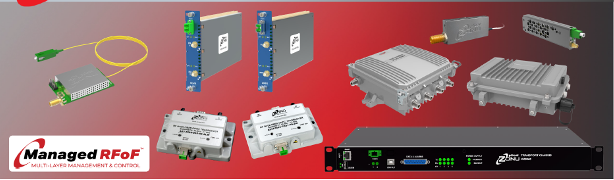
The OZ600 (low phase noise) is an RF over Fiber standalone flange mount module which may be configured as a transmitter, a receiver, or a transceiver (transmitter + receiver). Low phase noise reference fiber transport is offered in many additional form factors such as pigtailed OEM board, 19” chassis plug-ins and IP67 outdoor enclosures. Phase noise performance is optimized for references in the range 10 – 200 MHz.
Fiber links may be configured for unidirectional or bidirectional RF traffic. The OZ600 supports clock reference transport in situations where distance or flexibility of cabling may prohibit the use of coaxial cable. The OZ600 is packaged in a rugged dust-tight cast metal housing. The OZ600 features a linear optically isolated DFB laser diode operating at 1310 nm or 1550 nm and/or a high performance InGaAs photodiode. CWDM wavelengths are also available.
Standard transport is over 9/125 μm Single Mode Fiber, however Multimode fiber transport is also an option (contact Optical Zonu for details). The standard RF interface is 50 Ohm SMA and the standard optical interface is SC/APC (FC/APC is also available). Average Automatic Power Control (AAPC) provides closed loop control of the transmitter optical output power over the full operating temperature range. Alarm and monitoring functions are available through a DB9 connector. LEDs provide status of laser bias current (transmitter) and received optical power (receiver). The OZ600 module is powered from +12 VDC.
- Features
- Options
- Applications
- Phase Noise Optimized Over 10 – 200 MHz
- -40°C to +75°C Operating Temperature Range (1310 nm)
- Rugged Dust-Tight Housing
- 1310 nm, 1550 nm, CWDM Wavelengths
- Automatic Optical Power Control
- Local LED and Monitor/Alarm Indications
- Uncooled DFB Lasers
- Wide DC Power Input Range, +9V to +30V
- Lasers Conform to Class 1 Emission Level Per CDRH and IEC-825 (EN 60825) Standards
- Extended Low Frequency, down to 1 MHz
- Various form factors: OZ101, OZ500, OZ600, Rack Mount and Pluggable Rack Mounts J & J3U Integrated WDM
- Cooled DFB Lasers
- Multimode Fiber Capability
- Low Phase Noise Reference Clock Distribution
- L-band Satcom
- Antenna Remoting
- VSAT
- Maritime
LPN The OZ600 (low phase noise) is an RF over Fiber standalone flange mount module which may be configured as a transmitter, a receiver, or a transceiver (transmitter + receiver). Phase noise performance is optimized for references in the range 10 – 200 MHz.
Fiber links may be configured for unidirectional or bidirectional RF traffic. The OZ600 supports clock reference transport in situations where distance or flexibility of cabling may prohibit the use of coaxial cable. The OZ600 is packaged in a rugged dust-tight cast metal housing. The OZ600 features a linear optically isolated DFB laser diode operating at 1310 nm or 1550 nm and/or a high performance InGaAs photodiode. CWDM wavelengths are also available.
Standard transport is over 9/125 μm Single Mode Fiber, however Multimode fiber transport is also an option (contact Optical Zonu for details). The standard RF interface is 50 Ohm SMA and the standard optical interface is SC/APC (FC/APC is also available). Average Automatic Power Control (AAPC) provides closed loop control of the transmitter optical output power over the full operating temperature range. Alarm and monitoring functions are available through a DB9 connector. LEDs provide status of laser bias current (transmitter) and received optical power (receiver). The OZ600 module is powered from +12 VDC.