

Open Source vs. Closed Source Drones: What It Means for Fiber-Connected UAV Operations
As drone technology continues to evolve, unmanned aerial vehicles (UAVs) are increasingly used in defense, public safety, critical infrastructure, inspection, and industrial applications. While airframes and sensors often get the spotlight, the communications architecture behind drone operations is just as critical.
One of the most important — and often misunderstood — distinctions in UAV systems is the difference between open source and closed source drones, especially when it comes to fiber-based control and RF transport.
Two Types of Drones: Open Source and Closed Source
At a high level, drones fall into two categories:
Open Source Drones
Open source drones provide access to their communications protocols and control interfaces. This allows developers and system integrators to:
- Modify or customize control software
- Directly interface with RF links
- Experiment with alternative transport methods
Because of this openness, open source drones are often assumed to be the only viable option for fiber-connected or remote drone operations.
Closed Source Drones
Closed source drones, by contrast, operate as fully integrated systems. Their internal protocols are not accessible, and their RF links function like a black box — you can use them, but you can’t see inside or modify how they communicate.
Despite this limitation, closed source drones typically:
- Offer higher reliability
- Provide better system optimization
- Deliver consistent performance out of the box
As a result, closed source drones are often preferred for mission-critical and professional applications.
The Traditional Limitation of Closed Source Drones
Historically, closed source drones could not be used with fiber optic control systems. Because their internal protocols were inaccessible, there was no straightforward way to interface them with optical networks or extend control links beyond traditional RF ranges.
This limitation forced operators to choose between:
- Open source drones with fiber flexibility
or - Closed source drones with superior performance but limited connectivity
How Optical Zonu Changes the Equation
Optical Zonu’s RF over Fiber technology removes this tradeoff entirely.
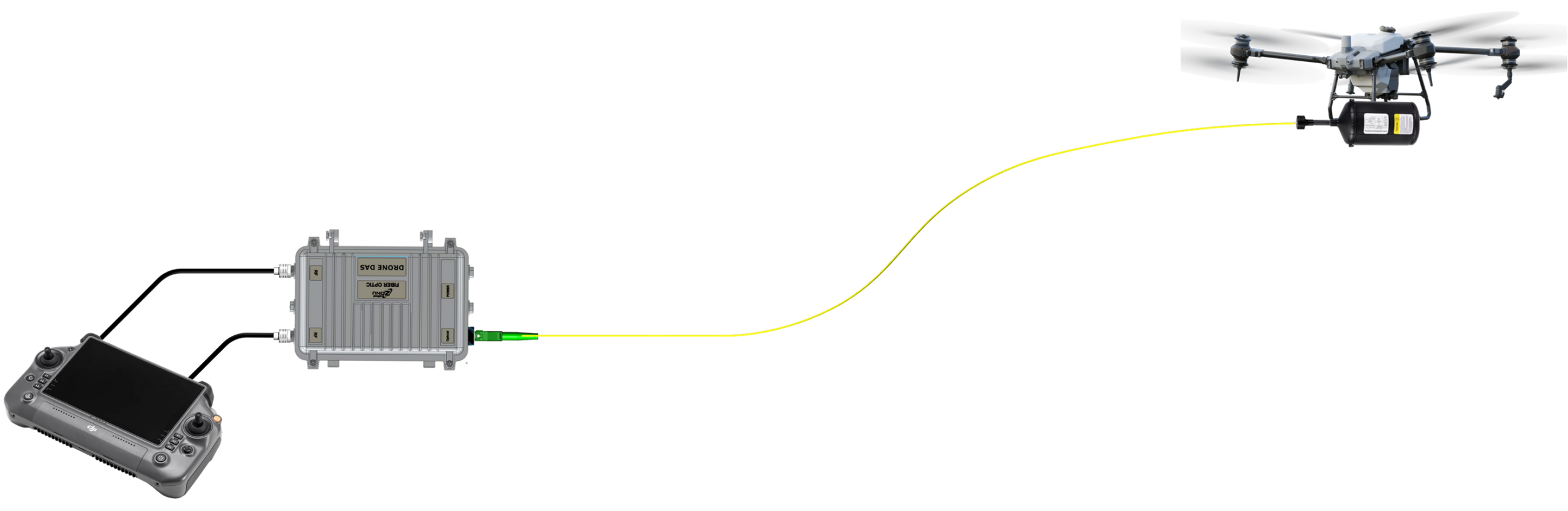
Rather than interfacing with a drone’s internal protocol, Optical Zonu solutions transport the RF signal itself over fiber. By converting RF to optical and back again, the system remains completely transparent to the drone — whether it is open source or closed source.
Because the RF signal is preserved end-to-end:
- The drone operates exactly as designed
- No access to internal protocols is required
- Closed source drones can be controlled over fiber
From the drone’s perspective, nothing has changed — except the range, reliability, and flexibility of the communications link.
Fiber Control for Any Drone Platform
By focusing on RF transport instead of protocol access, Optical Zonu drone links are:
- Compatible with ALL drone platforms
- Independent of manufacturer or firmware
- Suitable for both open source and closed source UAVs
- Ideal for long-distance, secure, and EMI-immune control links
This approach enables:
- Fiber-connected drone command and control
- Secure remote drone operations
- Deployment in RF-challenged or high-interference environments
- Integration into existing fiber infrastructure
A Future-Proof Approach to UAV Communications
As drone missions become more complex and more critical, operators need communication solutions that are flexible, reliable, and platform-agnostic.
Optical Zonu’s RF over Fiber technology provides a future-proof path forward — enabling fiber-based drone control without requiring access to proprietary systems, and without limiting operators to open source platforms.
Conclusion
The distinction between open source and closed source drones no longer defines what is possible with fiber-connected UAV operations. By transporting RF signals over fiber, Optical Zonu enables reliable, long-distance control of any drone platform, regardless of its internal architecture.
This capability allows organizations to deploy the best drone for the mission, without compromising on connectivity, performance, or scalability.
For more information please contact Dillon Harr [email protected]