

RF over Fiber for Radar Systems: Extending RF Signals with Optical Fiber
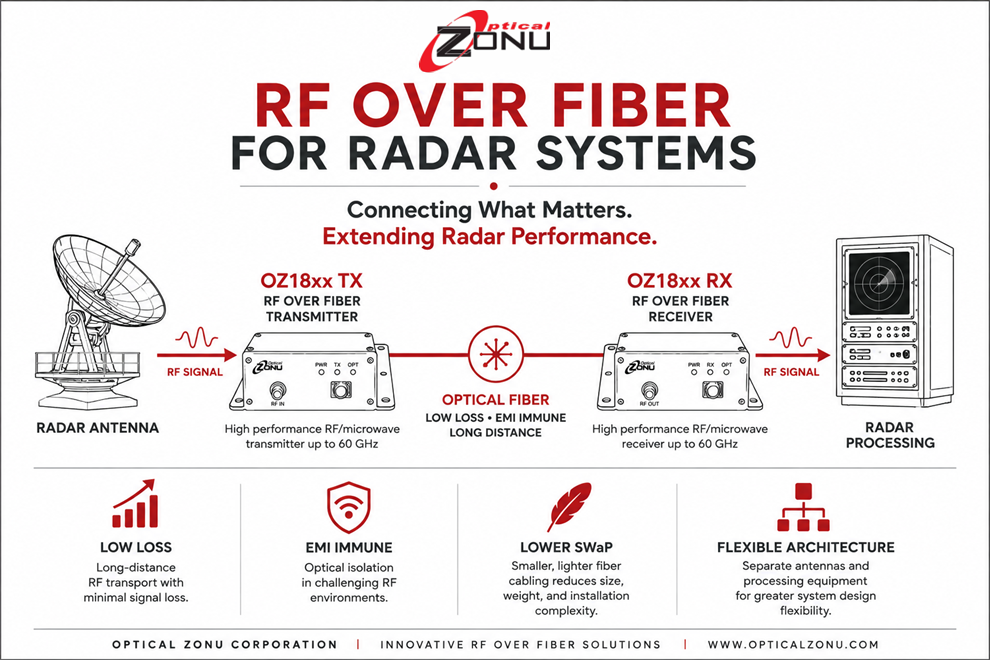
Radar systems depend on the accurate transport of RF and microwave signals between antennas, transmit/receive equipment, processing systems, and other mission-critical components. As radar frequencies increase and system architectures become more distributed, traditional coaxial cable can introduce challenges related to signal loss, distance, weight, electromagnetic interference, and installation flexibility.
RF over Fiber (RFoF) provides an alternative by converting RF signals to optical signals for transport over fiber and then converting them back to RF at the destination. This enables radar designers to separate antennas and processing equipment over much greater distances while maintaining the performance required by demanding RF systems.
Why Radar Systems Present an RF Transport Challenge
Radar installations can require RF signals to travel significant distances between antennas, processing equipment, control locations, and test systems.
Coaxial cable attenuation increases with both frequency and distance. At microwave frequencies, maintaining acceptable RF performance over long coaxial runs may require larger, heavier cable, additional amplification, or relocating sensitive electronics closer to the antenna.
Fiber changes that equation.
Because optical fiber provides very low transmission loss and is immune to electromagnetic interference, RF over Fiber allows engineers to transport RF and microwave signals over long distances without many of the physical and electrical limitations associated with copper transmission lines.
Fiber’s smaller size and lower weight can also be particularly valuable in airborne, mobile, shipboard, unmanned, and space-constrained radar installations.
How RF over Fiber Works in a Radar System
A typical radar RF over Fiber link begins with an RF or microwave signal entering an optical transmitter.
The transmitter converts the RF signal into an optical signal, which travels across optical fiber to a receiver. The receiver converts the optical signal back to RF for delivery to the radar processing equipment or other RF subsystem.
Depending on the system architecture, RF over Fiber links can support unidirectional or bidirectional signal transport, and multiple links can be used within distributed or multi-channel radar architectures. Optical Zonu’s existing RFoF platforms support transmitter, receiver, and transceiver configurations, including bidirectional operation.
Simplified Radar RFoF Architecture
Radar Antenna / RF Source
↓
RF over Fiber Transmitter
↓
Optical Fiber Link
↓
RF over Fiber Receiver
↓
Radar Processing / Control System
The result is a transparent RF transport link that allows the radar system to retain its RF interfaces while fiber handles the distance between locations.
Key Advantages of RF over Fiber for Radar
Lower Signal Loss Over Distance
One of the primary advantages of RF over Fiber is the ability to transport high-frequency signals over distances where coaxial cable loss becomes significant.
This gives radar designers greater flexibility when locating antennas, processing equipment, and control systems.
Immunity to Electromagnetic Interference
Optical fiber does not conduct electrical signals and is inherently immune to electromagnetic interference.
This can be especially important in radar environments where high-power RF transmitters and other electronic systems may create challenging electromagnetic conditions.
Electrical Isolation
Because the connection between locations is optical rather than conductive, fiber provides electrical isolation between RF equipment at opposite ends of the link.
Reduced Size and Weight
Fiber optic cable is substantially smaller and lighter than many high-performance microwave coaxial cables.
For airborne, unmanned, mobile, naval, and other SWaP-sensitive platforms, reducing cable size and weight can provide an important system-level advantage. Optical Zonu already offers RFoF modules specifically designed for compact and lightweight applications, including a 19-gram small-form-factor platform.
Flexible Antenna Placement
RF over Fiber allows antennas and RF equipment to be separated by distances that may be impractical using conventional coaxial infrastructure.
This makes it possible to place antennas where they perform best while locating processing and control equipment in more protected or convenient environments.
Radar Applications for RF over Fiber
RF over Fiber can be incorporated into a variety of radar environments, including:
- Ground-based radar systems
- Airborne radar
- Naval and shipboard radar
- Radar test ranges
- Surveillance systems
- Phased-array antenna systems
- Distributed radar architectures
- Antenna remoting
- Radar research and test systems
Optical Zonu’s current RF over Fiber portfolio specifically identifies radar RF signal transport and phased-array antenna systems among its supported applications.
Important Engineering Considerations
Selecting an RF over Fiber link for a radar system requires more than simply matching the operating frequency.
Several RF performance characteristics should be evaluated as part of the system design.
Frequency Range
The RFoF link must support the required radar operating frequencies and bandwidth. RF over Fiber platforms are available across a broad range of frequencies; for example, Optical Zonu’s OZ18xx platform supports RF/microwave transport up to 60 GHz.
Dynamic Range and Linearity
Radar receivers may need to process both weak and strong signals. The RF over Fiber link therefore needs sufficient dynamic range and linearity to transport those signals without introducing unacceptable distortion.
Spurious-free dynamic range (SFDR) can be an important specification when evaluating analog RF over Fiber links for these applications. Optical Zonu offers both high-SFDR broadband links and ultra-high-dynamic-range RFoF platforms intended for applications including radar RF distribution.
Noise Performance
Noise introduced by any component in the receive chain can affect overall system sensitivity. Engineers should therefore consider link noise performance together with gain and dynamic range when selecting an RFoF architecture.
Phase Stability
Radar architectures that depend on coherent processing or multiple synchronized RF channels can place additional requirements on phase stability and channel-to-channel performance.
For these systems, RF over Fiber should be evaluated as part of the complete radar signal chain rather than solely as a replacement for coaxial cable.
Environmental Requirements
Radar systems deployed outdoors, aboard aircraft or ships, or on mobile platforms may require equipment capable of operating across wide temperature ranges and in harsh environments.
RFoF form factor, enclosure, power requirements, monitoring capabilities, and environmental specifications should therefore be considered early in system design.
Selecting an RF over Fiber Solution for Radar
The appropriate RF over Fiber architecture depends on the radar system itself.
Engineers should consider:
- Operating frequency and bandwidth
- Required transport distance
- Dynamic range and linearity
- Noise performance
- Link gain
- Phase stability requirements
- Number of RF channels
- Unidirectional or bidirectional operation
- Size, weight, and power constraints
- Environmental conditions
- Monitoring and control requirements
- Future system expansion
For complex radar applications, working with an RF over Fiber supplier capable of adapting frequency range, gain, form factor, packaging, and system architecture can simplify integration and help ensure that the optical link complements the overall radar design.
Extending Radar Performance with Fiber
As radar systems become more distributed, operate at higher frequencies, and incorporate greater numbers of RF channels, moving RF signals efficiently between antennas and processing equipment becomes increasingly important.
RF over Fiber provides radar engineers with a flexible method of extending RF and microwave signals while reducing transmission loss, cable weight, EMI susceptibility, and the physical limitations associated with long coaxial runs.
By treating fiber as part of the radar system architecture rather than simply as a cable replacement, engineers can create more flexible, scalable, and distributed radar systems.
Related Links
RF over Fiber vs. Coaxial Cable