

PS Antenna Extender
Home / Solutions / Public Safety Wireless over Fiber / PS Antenna Extender
Home » Solutions » Wireless Distribution – Cellular and DAS » Public Safety Wireless over Fiber » PS Antenna Extender
Antenna Extender
Indoor coverage for Public Safety wireless services is an occupancy pre-req in many jurisdictions across the US. As this requirement is driven by coverage and not capacity, off-air connections to radio towers with wireless emergency services are generally sufficient. Where the signal from the outside cannot penetrate to provide adequate indoor coverage, a DAS (Distributed Antenna System) is used.
To pick up the needed Public Safety wireless signal, a directional donor antenna is mounted outdoors with a line of sight view to the donor site tower. This signal must then be amplified to a level sufficient to drive the DAS so a BDA (Bi-Directional Amplifier) or RF booster (FCC terminology) must be used.
In some cases, a coaxial cable connection between the donor antenna and the RF booster is not practical or possible to provide the coverage needed. This is usually because the cable run is too long making the RF losses too high. In these cases, Optical Zonu’s Antenna Extender provides a drop-in solution.
There are three cases where the Optical Zonu solution is needed to complete the system:
- Distance: The only location for the donor that has a strong signal from the donor site is too far from the RF booster location to use coaxial cable.
- Interference: Potential donor antenna locations that have a view of the donor site and that are close enough that coaxial cable could be used would jam the indoor coverage for nearby buildings.
- A single donor antenna must feed multiple RF boosters.
There are numerous Public Safety and Private Radio RF source and booster products that can provide two-way radio service coverage for indoor or blocked locations over coax – but making an efficient connection between these components can sometimes be problematic because of distance or cabling routing issues. Optical Zonu offers a range of RF over fiber optic links that support VHF, UHF, 700 MHz, 800 MHz and 900 MHz. This is a perfect solution for point-to-point and distributed systems for Public Safety, private SMR and government wireless networks.
Antenna Extender: Point-to-Point
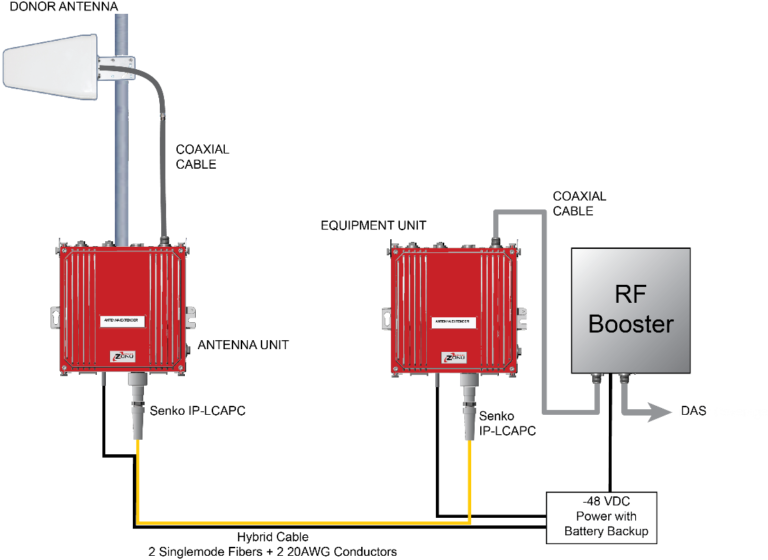
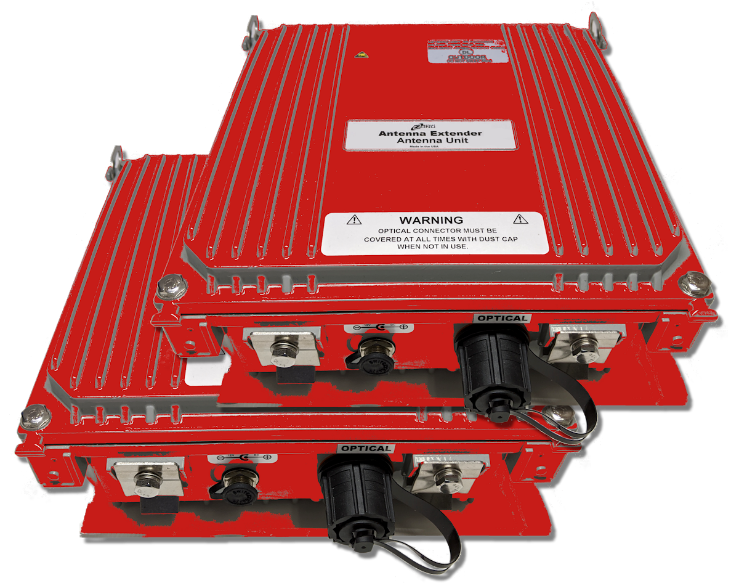
The Optical Zonu Antenna Extender is an RF-Over-Fiber coaxial cable replacement between the donor antenna and the RF booster. It is filtered to pass only the RF bands of interest thus preventing transmitting or receiving any interference. The Public Safety wireless version supports the 700/800 MHz bands. It connects directly to the RF booster and no adjustments are needed. The Antenna Unit connects to the donor antenna and can be powered locally or remotely. The Equipment Unit connects directly to the RF booster. As shown in the figure, the units can be powered locally or remotely. Remote powering permits installation of the Antenna Unit with the donor antenna on a mast in locations that have no local power. The -48 VDC power supply can support a voltage drop up to 12 VDC (4000 ft for 20 AWG wire). Also, this allows for the entire link to be centrally powered from a battery-backed up source in compliance with NFPA standards.
Antenna Extender: Simulcast to Multiple BDAs (Bi-Directional Point to Multi-point)
In this scenario, a multi-building facility is far from network macro coverage or is in a shadow zone where coverage is blocked by other structures or geography. In this case, the Optical Zonu Antenna Extender is available in a configuration that can distribute the donor signal for up to eight locations. The downlink signal is split eight ways by an optical splitter. The Equipment Units are modified with additional downlink gain to compensate for the additional losses. For the uplink, the laser in each Equipment Unit is set to a different CWDM (coarse wave division multiplex) wavelength so that, when combined they do not interfere with one another. Each Equipment Unit then connects to an RF booster that drives the DAS in that building.
Optical Zonu Distributed Antenna Extender. This configuration permits simulcasting of the off-air mobile wireless signals for up to 8 RF boosters each driving a DAS in different buildings.
Antenna Extender
Indoor coverage for Public Safety wireless services is an occupancy pre-req in many jurisdictions across the US. As this requirement is driven by coverage and not capacity, off-air connections to radio towers with wireless emergency services are generally sufficient. Where the signal from the outside cannot penetrate to provide adequate indoor coverage, a DAS (Distributed Antenna System) is used.
To pick up the needed Public Safety wireless signal, a directional donor antenna is mounted outdoors with a line of sight view to the donor site tower. This signal must then be amplified to a level sufficient to drive the DAS so a BDA (Bi-Directional Amplifier) or RF booster (FCC terminology) must be used.
In some cases, a coaxial cable connection between the donor antenna and the RF booster is not practical or possible to provide the coverage needed. This is usually because the cable run is too long making the RF losses too high. In these cases, Optical Zonu’s Antenna Extender provides a drop-in solution.
There are three cases where the Optical Zonu solution is needed to complete the system:
- Distance: The only location for the donor that has a strong signal from the donor site is too far from the RF booster location to use coaxial cable.
- Interference: Potential donor antenna locations that have a view of the donor site and that are close enough that coaxial cable could be used would jam the indoor coverage for nearby buildings.
- A single donor antenna must feed multiple RF boosters.
Antenna Extender: Point-to-Point
The Optical Zonu Antenna Extender is an RF-Over-Fiber coaxial cable replacement between the donor antenna and the RF booster. It is filtered to pass only the RF bands of interest thus preventing transmitting or receiving any interference. The Public Safety wireless version supports the 700/800 MHz bands. It connects directly to the RF booster and no adjustments are needed. The Antenna Unit connects to the donor antenna and can be powered locally or remotely. The Equipment Unit connects directly to the RF booster. As shown in the figure, the units can be powered locally or remotely. Remote powering permits installation of the Antenna Unit with the donor antenna on a mast in locations that have no local power. The -48 VDC power supply can support a voltage drop up to 12 VDC (4000 ft for 20 AWG wire). Also, this allows for the entire link to be centrally powered from a battery-backed up source in compliance with NFPA standards.
Antenna Extender: Simulcast to Multiple BDAs (Bi-Directional Point to Multi-point)
In this scenario, a multi-building facility is far from network macro coverage or is in a shadow zone where coverage is blocked by other structures or geography. In this case, the Optical Zonu Antenna Extender is available in a configuration that can distribute the donor signal for up to eight locations. The downlink signal is split eight ways by an optical splitter. The Equipment Units are modified with additional downlink gain to compensate for the additional losses. For the uplink, the laser in each Equipment Unit is set to a different CWDM (coarse wave division multiplex) wavelength so that, when combined they do not interfere with one another. Each Equipment Unit then connects to an RF booster that drives the DAS in that building.
Optical Zonu Distributed Antenna Extender. This configuration permits simulcasting of the off-air mobile wireless signals for up to 8 RF boosters each driving a DAS in different buildings.