

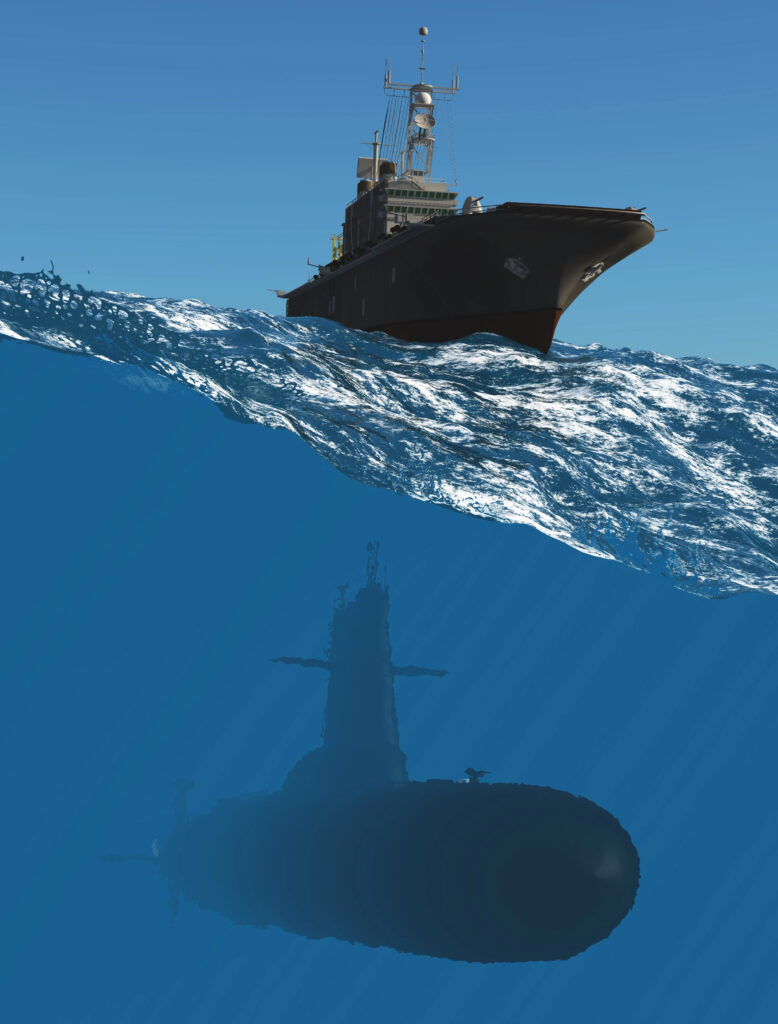
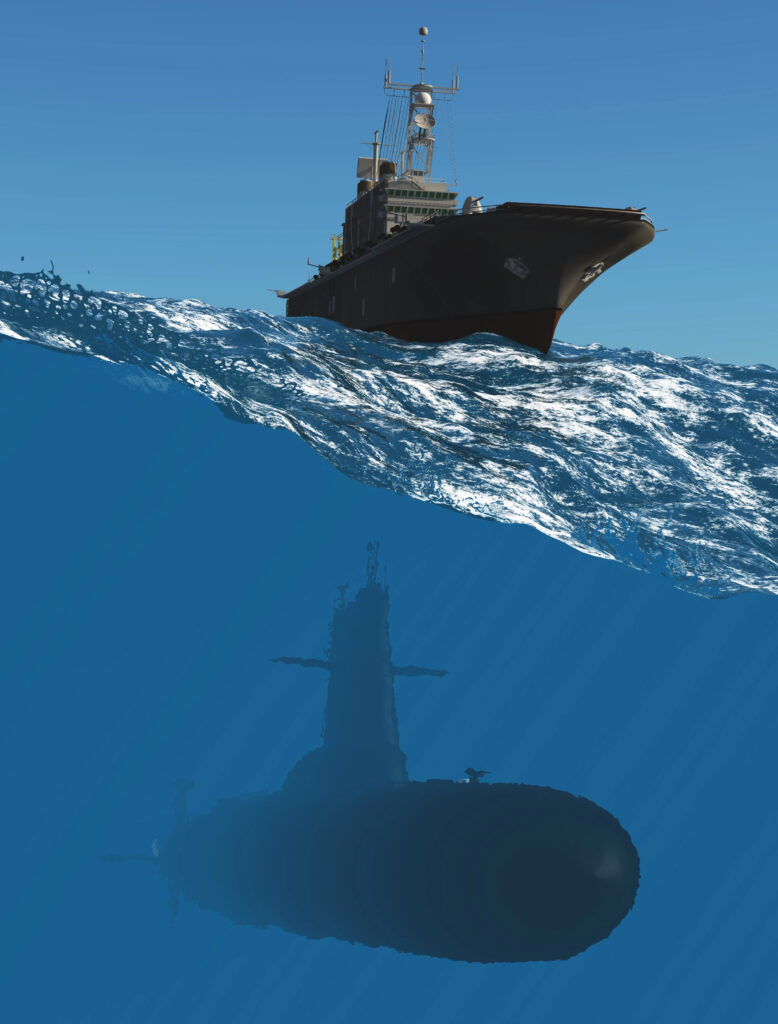
Naval and Submarine RF over Fiber Architecture
Naval and submarine platforms rely on increasingly complex RF systems to support communications, radar, telemetry, navigation, timing, surveillance, and mission-critical data links. These systems often need to move high-frequency signals between antennas, radios, modems, equipment rooms, command centers, and mission systems across challenging physical environments.
In many naval applications, traditional coaxial cable and waveguide can create design limitations. Long coaxial runs may introduce signal loss. Waveguide can be heavy, rigid, and difficult to route through constrained shipboard spaces. Electromagnetic interference, platform weight, cable routing, and equipment placement all become important system-level considerations.
RF over Fiber provides a flexible alternative for transporting RF signals optically across naval, shipboard, and submarine environments. By converting RF signals to optical signals for transport over fiber, RF over Fiber links can help engineers extend RF signal paths while reducing the limitations associated with long metallic transmission lines.
For naval and defense system designers, RF over Fiber applications may include Common Data Link support, antenna remoting, waveguide replacement, radar signal transport, GPS/GNSS timing distribution, SATCOM connectivity, and secure RF signal distribution across complex platforms.
Why Naval Systems Use RF over Fiber
Naval platforms present a demanding environment for RF signal transport. Equipment may be separated by long distances. Antennas may need to be located above deck, while radios, control systems, and mission equipment remain below deck or inside protected equipment spaces. In other cases, RF signals may need to be distributed between multiple compartments, shelters, or command areas.
RF over Fiber can help address these challenges by allowing RF signals to travel over optical fiber rather than coaxial cable or waveguide.
Key advantages include:
- Reduced cable weight compared with many metallic RF transmission lines
- Improved routing flexibility in space-constrained environments
- Long-distance RF signal transport
- Immunity to electromagnetic interference
- Electrical isolation between system elements
- Flexible antenna remoting
- Support for centralized equipment rooms
- Reduced need for long coaxial or waveguide runs
For shipboard RF systems, these advantages can be significant. Fiber optic cable is lightweight, flexible, and easier to route through complex structures. This can help simplify system architecture, especially when antennas, RF equipment, and control systems cannot be located near one another.
In naval communications systems, RF over Fiber links may be used to move signals from remote antennas to below-deck electronics, distribute RF signals between operational areas, or support equipment relocation without sacrificing signal integrity over distance.
RF over Fiber for CDL and Tactical Communications
Common Data Link, or CDL, and related tactical communication systems often require reliable RF signal transport between antennas, radios, modems, processors, and mission systems. These environments may involve aircraft, ships, ground stations, shelters, command centers, and other defense platforms where long RF cable runs can create performance and installation challenges.
In CDL applications, RF over Fiber links can help transport RF signals across distance while reducing the physical burden of coaxial cable or waveguide. This may be especially useful when system designers need to separate antennas from protected electronics or route signals through areas where metallic cable paths are difficult or impractical.
RF over Fiber can also support tactical communication architectures where equipment placement is driven by operational requirements, available space, platform design, or environmental protection. Instead of forcing radios and modems to be located near antennas, RFoF links can provide greater flexibility in where critical systems are installed.
For defense RFoF systems, this flexibility can support:
- Remote antenna placement
- Below-deck equipment location
- Tactical data link signal transport
- Shelter-to-antenna connectivity
- Command center RF distribution
- Secure signal routing across complex platforms
In many cases, the value of RF over Fiber is not only about distance. It is also about design freedom. Engineers can place antennas where they perform best and equipment where it is most protected, serviceable, or practical.
Waveguide Replacement in Shipboard and Naval Platforms
Waveguide has long been used in high-frequency RF and microwave systems because of its performance characteristics at certain frequencies. However, waveguide can also create significant mechanical and installation challenges, particularly in naval and shipboard environments.
Waveguide is often rigid, heavy, and difficult to route. It may require precise mechanical installation, careful alignment, and substantial physical space. In platforms where space and weight are critical, long waveguide runs can become a major design constraint.
RF over Fiber can provide a practical alternative in some waveguide replacement applications. By converting RF signals to optical signals, transporting them over fiber, and converting them back to RF at the destination, system designers may be able to reduce the need for long, heavy, or difficult-to-route waveguide paths.
This can be especially valuable in shipboard RF systems where antennas, radar equipment, receivers, transmitters, or control systems are separated by distance or located in different compartments.
Potential benefits of RF over Fiber for waveguide replacement include:
- Lower cable weight
- Easier routing through confined spaces
- Reduced installation complexity
- Greater flexibility in equipment placement
- Less dependence on rigid metallic transmission paths
- Improved EMI immunity
- Better support for modular system design
RF over Fiber is not a universal replacement for every waveguide application. Frequency range, signal power, dynamic range, noise performance, link budget, and environmental conditions all need to be evaluated. However, for many signal transport applications, RFoF can offer an attractive alternative when waveguide becomes too heavy, rigid, expensive, or difficult to install.
RF Signal Transport in Submarine Environments
Submarine platforms introduce some of the most challenging physical constraints for RF system design. Space is limited. Cable routing can be complex. Equipment placement is tightly controlled. Electromagnetic compatibility, reliability, and system integration are all critical.
While submarines are often associated with specialized communications and antenna systems, many of the same RF signal transport challenges apply: signals must move between antennas, receivers, transmitters, control systems, navigation equipment, and mission electronics within a constrained platform.
RF over Fiber can support submarine RF applications by providing a lightweight, flexible, EMI-resistant method of transporting RF signals across sections of the platform. Fiber optic links may help reduce the need for long coaxial runs, simplify routing, and support separation between antenna locations and protected equipment areas.
In submarine and naval environments, RF over Fiber may be considered for:
- RF antenna remoting
- Communication signal transport
- Radar support systems
- Timing and reference distribution
- Test and monitoring systems
- Above-deck or mast-related signal routing
- Below-deck equipment connectivity
- Mission system RF distribution
It is important to distinguish this type of application from undersea telecom cable systems. In this context, submarine fiber optics refers to the use of fiber optic links inside or as part of submarine platform RF infrastructure, not long-haul subsea communication cables.
For submarine platform designers, the value of RF over Fiber often comes from compact routing, electrical isolation, reduced EMI sensitivity, and the ability to transport RF signals through difficult physical pathways.
Radar, Antenna Remoting, and Timing Distribution
RF over Fiber applications extend beyond communications. Naval and defense platforms may also use RFoF links to support radar systems, antenna remoting, GPS/GNSS timing, SATCOM terminals, telemetry, test systems, and distributed RF architectures.
In radar-related applications, RF over Fiber can help move RF or microwave signals between antenna locations, processing equipment, control rooms, and protected electronics. This may allow sensitive equipment to be located away from harsh environmental exposure while maintaining signal connectivity to antennas or front-end systems.
For antenna remoting, RF over Fiber allows antennas to be installed in optimal locations while RF electronics remain in more accessible or protected areas. This is useful in shipboard, ground station, shelter, and command center environments where antenna placement and equipment placement are often driven by different requirements.
GPS and GNSS timing distribution is another important area. Naval and defense systems may require precise timing references across multiple subsystems. Fiber-based signal transport can help distribute GPS/GNSS signals or timing references across platforms while reducing the losses and interference concerns associated with long coaxial runs.
Common RF over Fiber applications in naval and defense systems may include:
- Radar signal transport
- Antenna remoting over fiber
- SATCOM signal distribution
- GPS/GNSS over fiber
- Timing and reference signal distribution
- Telemetry links
- Test range RF transport
- Command center RF distribution
- Multi-antenna system connectivity
These applications all share a common requirement: moving RF signals reliably across distance, through complex environments, and between system elements that may not be physically close together.
RF over Fiber Limitations and Design Considerations
RF over Fiber offers many advantages, but it must be engineered correctly. Like any RF transport technology, system performance depends on the full link design.
Important design considerations include:
- Frequency range
- Link distance
- Optical loss
- RF input and output levels
- Gain distribution
- Noise figure
- Dynamic range
- Spurious-free dynamic range
- Linearity
- Optical power budget
- Connector quality
- Temperature range
- Environmental conditions
- Mechanical packaging
- Power availability
- System redundancy requirements
For example, a naval RF over Fiber link used for low-level receive signals may have different requirements than a link used in a high-dynamic-range radar support application. Similarly, a GPS timing distribution link will have different performance priorities than a broadband tactical communications link.
RF over Fiber limitations are usually not a reason to avoid the technology. Instead, they are reasons to design the link properly. Engineers need to evaluate the required frequency range, signal levels, acceptable noise contribution, distance, optical loss, and environmental requirements before selecting the right RFoF architecture.
A properly designed RF over Fiber system can provide excellent performance, but the link must be matched to the application.
Optical Zonu RFoF Solutions for Naval and Defense Applications
Optical Zonu provides RF over Fiber solutions for demanding commercial, defense, aerospace, wireless, satellite, timing, and communications applications. For naval and submarine environments, Optical Zonu RFoF technology can support flexible RF signal transport where coaxial cable, waveguide, or traditional RF distribution methods may create limitations.
Optical Zonu solutions can support applications such as:
- RF over Fiber links
- Antenna remoting
- Waveguide replacement
- CDL and tactical communication support
- Radar signal transport
- GPS/GNSS over fiber
- SATCOM signal distribution
- Timing and reference distribution
- Custom RFoF system design
- Multi-link RF transport architectures
Because naval and defense applications often have unique requirements, Optical Zonu works with engineers to understand frequency range, link distance, signal levels, dynamic range, environmental needs, packaging constraints, and platform-specific design goals.
Whether the application involves a shipboard RF system, submarine platform, tactical communication link, radar support system, or antenna remoting requirement, RF over Fiber can provide a flexible and scalable approach to mission-critical RF signal transport.
Conclusion
Naval and submarine RF systems require reliable signal transport across some of the most challenging environments in the world. Coaxial cable and waveguide remain important technologies, but they can also introduce limitations related to weight, routing, distance, EMI, and platform design flexibility.
RF over Fiber gives system designers another option.
By converting RF signals to optical signals and transporting them over lightweight fiber optic cable, RF over Fiber links can support naval communications, CDL applications, waveguide replacement, antenna remoting, radar signal transport, timing distribution, and submarine RF infrastructure.
For engineers designing complex naval and defense platforms, RF over Fiber can help reduce physical constraints while preserving the RF connectivity needed for modern mission systems.
For more information go to Antenna Remoting – CDL.
OR
Contact Optical Zonu to discuss RF over Fiber solutions for naval, submarine, shipboard, radar, timing, CDL, and defense RF signal transport applications. [email protected]