

RF over Fiber in Aerospace & Defense Applications
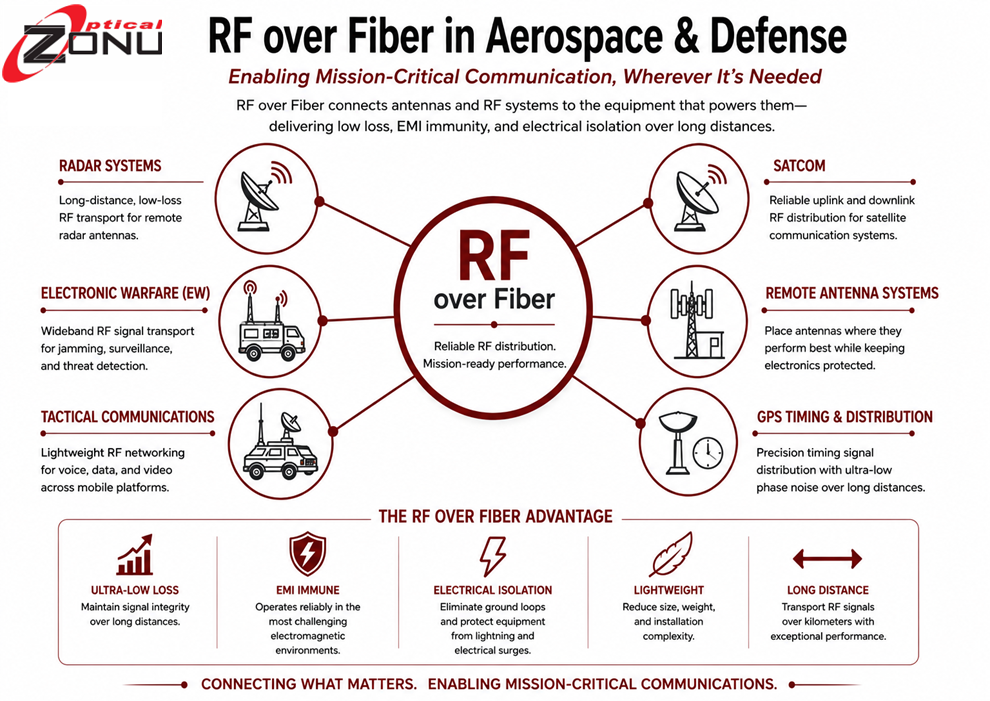
Supporting Mission-Critical Communications, Radar, SATCOM, and Electronic Warfare
Modern aerospace and defense systems rely on the reliable transmission of high-frequency RF signals to support radar, satellite communications, electronic warfare, tactical communications, and timing systems. Whether deployed on ships, aircraft, fixed installations, or mobile tactical platforms, maintaining RF signal integrity is essential for mission success
As operating frequencies increase and platforms become more distributed, traditional coaxial cable often becomes a limiting factor due to signal loss, weight, electromagnetic interference (EMI), and installation complexity.
RF over Fiber (RFoF) technology overcomes these limitations by transporting RF signals over optical fiber with extremely low loss while providing complete electrical isolation and immunity to electromagnetic interference. These advantages have made RF over Fiber an enabling technology for many of today’s most demanding defense applications.
Engineering Challenges in Aerospace & Defense
Defense communication systems frequently require antennas to be located hundreds or even thousands of feet away from the equipment they serve. Whether mounted on radar towers, ships, aircraft, remote shelters, or tactical vehicles, these antennas must maintain exceptional signal integrity under harsh environmental conditions.
Engineers designing these systems commonly face challenges including:
- High RF signal loss over long coaxial cable runs
- Electromagnetic interference (EMI) and radio frequency interference (RFI)
- Lightning strikes and ground loop susceptibility
- Size, Weight, and Power (SWaP) constraints
- Remote antenna placement requirements
- Harsh environmental conditions
- Equipment survivability and system reliability
These challenges become increasingly significant as operating frequencies extend into the microwave and millimeter-wave spectrum.
Why RF over Fiber?
RF over Fiber directly addresses many of the limitations associated with traditional coaxial cable distribution.
Because optical fiber introduces only a fraction of the loss experienced by coaxial cable, RF signals can be transported over much greater distances while maintaining signal quality. This allows sensitive RF electronics to remain safely housed inside protected shelters while antennas are installed in their optimal operating locations.
Unlike copper cabling, optical fiber is completely immune to electromagnetic interference, making it ideal for electrically noisy military environments where radar systems, high-power transmitters, generators, and electronic warfare equipment operate in close proximity.
Optical fiber also provides complete electrical isolation, eliminating ground loops while protecting valuable electronics from lightning-induced surges and electrical faults.
Additionally, fiber optic cable is significantly lighter and smaller than comparable coaxial cable, reducing installation complexity while supporting modern SWaP requirements found in aircraft, naval platforms, and mobile communication systems.
Typical Aerospace & Defense Applications
RF over Fiber technology is used across a wide range of defense applications where reliable RF transport is essential.
Radar Systems
Remote radar antennas often require equipment shelters to be located hundreds of feet away. RF over Fiber enables low-loss transmission between the radar electronics and the antenna while reducing cable weight and minimizing signal degradation.
Satellite Communications (SATCOM)
Ground terminals and shipboard SATCOM systems frequently use RF over Fiber to transport uplink and downlink signals between indoor equipment and outdoor antennas while preserving signal quality across long distances.
Electronic Warfare (EW)
Electronic warfare systems rely on accurate transport of wideband RF signals for surveillance, jamming, signal intelligence, and threat detection. RF over Fiber provides excellent bandwidth while eliminating susceptibility to electromagnetic interference.
Tactical Communications
Military communication networks benefit from fiber’s lightweight construction, electrical isolation, and ability to distribute RF signals across large installations without the performance limitations of traditional coaxial cable.
GPS Timing and Synchronization
Accurate timing signals are critical for many defense platforms. RF over Fiber enables the reliable distribution of GPS reference signals with extremely low phase noise while maintaining excellent long-distance performance.
Remote Antenna Systems
By allowing antennas to be positioned where they perform best while locating sensitive electronics in protected environments, RF over Fiber improves both system performance and equipment survivability.
Design Considerations
When designing RF over Fiber systems for aerospace and defense applications, engineers should consider several important factors:
- Operating frequency range
- RF gain and system noise figure
- Optical link budget
- Dynamic range and linearity
- Environmental operating conditions
- Connector selection
- Redundancy and reliability requirements
Selecting the appropriate RF over Fiber architecture ensures optimal performance while meeting the demanding reliability expectations of defense programs.
Conclusion
As aerospace and defense systems continue to operate at higher frequencies and over greater distances, RF over Fiber has become an increasingly important technology for reliable RF signal transport.
By combining extremely low transmission loss, immunity to electromagnetic interference, electrical isolation, lightweight construction, and long-distance performance, RF over Fiber enables engineers to overcome many of the limitations associated with traditional coaxial cable.
From radar and SATCOM to electronic warfare and tactical communications, RF over Fiber continues to support mission-critical systems where performance, reliability, and survivability are essential.
Continue Exploring